Monday, June 13, 2022

My Cousin Trudy, Her Stallion Karonek, and the First Scottsdale Arabian Horse Show (with a cameo by Zayne, John Wayne’s Arabian)

 Tobi Lopez Taylor

 This essay is part of the ongoing Arizona Horse History Project series, which also includes posts on Penny Chenery and SecretariatHank the CowdogMan O Wars son By HisselfMajor-General Jonathan Burton, and Doc Pardee


        Almost anyone in North America who’s involved in showing Arabian horses knows about Arizona’s Scottsdale Arabian Horse Show, which was founded in 1955 with financial support from  Fowler and Anne McCormick; Philip and Helen Wrigley; and Ed and Ruth Tweed. (I’ve written about all three couples here, here, and here.)

Ed Tweed’s champion Skorage at the Arizona Biltmore arena


        In 1955, there were only 14 shows in the entire U.S. that were strictly for Arabians, and the modern U.S. and Canadian National Championship shows hadn’t been invented yet. In addition, the Scottsdale Show wasn’t yet known as the Scottsdale Show, in part because it wasn’t initially held in Scottsdale. Rather, that first show was a two-day affair held in Phoenix, in the arena of the Arizona Biltmore Hotel, which was then owned by the Wrigley family. (In contrast, today’s Scottsdale Show is an 11-day event that takes place at the city’s WestWorld facility. It offers hundreds of classes, in a variety of disciplines, and draws Arabians and Half-Arabians from across the U.S. as well as several foreign countries. It also adds upward of $50 million to the local economy during those 11 days.)

        Back in February 1955, a total of 135 Arabians competed at the first not-quite-Scottsdale Show. In addition to the Arizona entries, horses also arrived from California, New Mexico, Texas, and Utah. The list of owners was a “Who’s Who” of that era’s Arabian fanciers, including John M. Rogers, E. E. Hurlbutt, Frank and Helen McCoy, Harvey Ellis, Owen McEwen, Carol Chapman, and Gerald Donoghue. (Of all the competitors, the latter’s horses may have traveled the farthest to Phoenix, making a 2,000-mile round-trip journey from Goliad, Texas.)

        Even though the show was relatively small, with only 27 classes, it attracted some high-profile Arabians, including Ibn Hanrah (a future Canadian National Champion Stallion), the future U.S. Top Ten Stallions Natez and Habu, and the future U.S. and Canadian Top Ten Mare Rose Rahnafin. The show’s first champion stallion, Tisaan, is remembered as the sire of Hillcrests Tishamba, winner of three National titles, while the first champion mare, *Serafire, later produced two U.S. Top Ten Mares.


        The focus of this essay, however, is on  the winner of the 1955 Scottsdale Show’s Western Stake class: the well-bred champion stallion Karonek, owned by Mr. and Mrs. W. E. Trimmell of Westminster, California. Mrs. Trimmell—the former Gertrude “Trudy” Eldridge—was born in Arizona in 1914. Trudy’s mother (Nettie Lee Norwood) and my grandmother were first cousins. My grandmother’s extended family hailed from Arkansas, and a number of her Norwood relations made their way to Arizona in the early 1900s.

        One of those Norwood relatives—Trudy’s uncle, James “Jasper” Norwood (1883–1972)—sent my grandmother a photo postcard in 1920 showing Jasper himself driving a “skidder” in northern Arizona. Jasper was a cowboy and muleskinner, and he eventually retired to the Arizona Pioneers’ Home, in Prescott, in 1961. Jasper’s decade-long tenure at the home closely overlapped that of Eugene “Pecos” Higgins (1883–1971), who arrived in 1962. Higgins—a cowboy, performer with the Miller 101 Ranch Show, and celebrated cowboy poet—is best known for composing the poems “Barney” and “Looking For Work.” How well Jasper and Pecos were acquainted is unknown, but during the decade they lived in the Pioneers’ Home, they surely would have had a lot in common to talk about.

        As for Cousin Trudy, I met her only once, but she made quite an impression on me. In the summer of 1976 or thereabouts, this well-dressed woman visited my grandmother at her house on Moreland Street in Phoenix for the first and only time, and I—age 11 or so—happened to be there. When Trudy arrived, I was sitting on what my grandmother called the “settee,” reading a horse book. Trudy noticed that and said, “My husband and I used to have horses—Arabian horses.” I was so excited! An actual family member had owned Arabians! I recall telling her they were my favorite breed and informing her that only two years earlier I’d attended my very first Scottsdale Show at McCormick Ranch (for more about that, go here).

        Trudy then mentioned that she and her husband, Dick, not only owned Arabians but bred and showed them as well. When I pressed her for more details, Trudy replied, “That was a long time ago!”  Then, deciding she’d humored me long enough,  she went back to talking to my grandmother, and they sat down at the yellow formica kitchen table to discuss Norwood family history, the reason for Trudy’s visit.


KARONEK

            What Trudy hadn’t told me during our single, brief conversation was that she and her husband had owned and showed the well-regarded champion stallion Karonek. More than 40 years after Trudy and I met, I happened to notice this 1953 advertisement, with their names as his owners:  


        Karonek, born in 1947, was bred by Dr. and Mrs. Claude Steen of Fullerton, California. His sire, *Raseyn, had been imported in 1926 to Pomona, California, by Carl Raswan for cereal magnate W. K. Kellogg. Then a three-year-old, *Raseyn was among the first offspring of the famous Skowronek to arrive in the U.S. from England’s Crabbet Stud, established by Wilfrid and Lady Anne Blunt. Kellogg liked to have his Arabians in the public eye, so *Raseyn appeared in parades, participated in the ranch’s Sunday Shows, was sculpted by Annetta Johnson Saint Gaudens, had his picture taken with various movie starlets,  and appeared in motion pictures, including The Scarlet Empress.

        *Raseyn proved to be a notable breeding stallion. His daughter Angyl was an early U.S. National Top Ten Mare. The first U.S. National Champion Stallion and Mare, Mujahid and Surita, were grandget of his. Marian Carpenter included *Raseyn in her book Arabian Legends, which devoted a chapter apiece to 24 of the best-known horses the breed has produced. Also honored in her book were six of *Raseyn’s descendants: Bay-Abi, Bay El Bey, Ferzon, Khemosabi, Skorage, and Xenophonn.

        In 1948, the year after Karonek’s birth, it was determined that *Raseyn (now 25) was sterile. During World War II, the Kellogg Ranch had been donated to the U.S. Army and was designated an Army Remount Station. Army protocol demanded that any “non-functioning” horse, like the elderly *Raseyn, be destroyed. Somehow, Arabian breeder Alice Payne, of Whittier, California, got word of *Raseyn’s impending death. According to breed historian Andrew Steen, Payne asked the man who ran the local grocery store if his son—a newly elected U.S. Congressman named Richard Nixon—could help her. Steen noted that Nixon “pulled some strings,” and *Raseyn went on to live out his days at Payne’s Asil Arabians. (See here for more on Richard Nixon and Arabian horses.) Interestingly, this episode took place around the same time that Nixon, a member of the House Un-American Activities Committee, was trying to expose Alger Hiss, a career State Department employee, as a Communist. (I highly recommend John Berresford’s podcast on Hiss.) Within a few years, Hiss went to  jail and Nixon became Eisenhower’s Vice President. Later, Nixon’s daughters Julie and Tricia learned to ride on a descendant of *Raseyn named Gali-Ferra, a gift to President Eisenhower from breeder Daniel Gainey (for more on Gainey, see here and here).

        Karonek’s dam, Kasila, was bred by newspaper magnate William Randolph Hearst. She was predominantly of Davenport breeding—i.e., horses brought from Syria in 1906 by political cartoonist Homer Davenport, who at one time worked for Hearst. (See here for more on Davenport and Hearst.) One of Kasila’s ancestors, the stallion *Muson, is famous today for having been ridden by William “Buffalo Bill” Cody at Madison Square Garden. Interestingly, Kasila’s dam, Alilatt, foaled in 1927, has an Arizona connection: both her sire, Saraband (Harara x Sedjur), and her grandsire, El Jafil (*Ibn Mahruss x Sheba), were purchased by General Levi Manning, onetime mayor of Tucson, for his breeding program at Canoa Ranch. Manning was the first Arizonan to breed purebred Arabians, and he was guided in his purchases by self-proclaimed horse expert Hamilton Bassett, whose wife, Betty Bassett, was Alilatt’s breeder. (See here for more on the Bassetts.)

        Although Kasila produced 10 foals, Karonek was far and away her most high-profile offspring. He won lots of blue ribbons and BIG trophies,” according to Cousin Trudy’s son, David Trimmell, who was a young child during the period that his folks were breeding and showing Arabians. The earliest documentation I’ve found for Karonek in the Trimmells’ ownership is May 1952, when he won the stallion championship at an Arabian horse show in Westminster, California. (I wasn’t able to ask Trudy and Dick my questions, as both are long deceased.)

THE TRIMMELL BROTHERS

It’s possible that Trudy and Dick became involved with the breed because Dick’s brother and sister-in-law, J. D. and Chrystie Trimmell, who also lived in California, had purchased Arabians in the late 1940s and became involved in showing them. By 1953, J. D. was the vice president of the Arabian Horse Association of Northern California. The Trimmell brothers were originally from Kansas and were distantly related to other horse-owning Trimmells, including some who bred Arabians.

The earliest Arabian I’ve traced to J. D.’s ownership is the 1937 gelding El Farkad (Ribal x Fasal), bred in Arizona by Robert T. Wilson. J. D. purchased the horse sometime after 1944 and sold him in 1949. Owning El Farkad may have been the impetus for J. D. and Chrystie to begin breeding their own Arabs in the late 1940s at their JDT Ranch, located first in Porterville and then in Lafayette, California.


        JDT Ranch purchased the mares Othmadeyna (Ferdeyn x Othmanee), Ferviseynna (Ferseyn x Vivienna), and Claraea (Sahiby x Sanada) to use as breeding stock. The first two mares were closely related—their sires were of the *Raseyn male line and their dams were both by Joon (*Azra x Dahura), a stallion of primarily Davenport bloodlines. The very successful *Raseyn-Joon cross appears in the pedigrees of notable horses such as Courier (sire of four National winners); Latsemah (dam of three National winners for Ed Tweed’s Brusally Ranch, each by a different sire); and Aza Destiny (Canadian Reserve National Champion Stallion, U.S. Top Ten Stallion, and Scottsdale Champion Stallion).


        Othmadeyna produced five foals for JDT Ranch (photo courtesy of Dolores Adkins). Her son Redraff turned out to be a useful sire for Ralph Smith in Montana; a granddaughter of Redraff, named Murzadaii, was 1969 U.S. Top Ten in Western Pleasure. Another son, Othmadareb, sired only three foals. One of Othmadarebs foals, Nevada Traveler, was out of John Rogers’s notable desertbred mare *Thorayyah; she also produced Ankthor, a record-setting Tevis Cup winner who was shown at halter by Dick Trimmell. Othmadeyna was sold in 1953 to Mrs. and Mrs. A. D. Lindsay of Walnut Creek, California.

       Othmadeyna’s grandson Nevada Traveler was initially quite unprepossessing. According to a March 1959 Western Horseman article, he was purchased from his breeder (Rogers) by a young girl but “soon showed why he had been sold. He bit everybody that came to see him, broke down stall doors, chewed up lead ropes, and got into the grain bin.” He was nicknamed “Stinky” because of his poor attitude. Finally, his trainer “decided to make a cow pony out of him—since that seemed to fit his aggressive temperament.” He started to win cutting classes and capped off his career by competing in the 1958 Nevada State Championship Horse Show, where he “won open hackamore, Western pleasure, champion Arabian hackamore horse for 1958, champion Arabian Western pleasure horse, champion Arabian gelding, and came within one point of being reserve champion open hackamore horse.”


Ferviseynna had three foals for JDT Ranch. She was closely related to Karonek; they shared the same sireline and damline. (Perhaps J. D. instigated his brother’s purchase of Karonek, since those bloodlines had worked so well for him.) Ferviseynna’s son Faroseyn was sold to Dick and Trudy, and Dick showed him. Ferviseynna’s daughter Maarseynna had a number of foals by Karonek, including the champion mare Karoneynna, who was purchased from Dick and Trudy by Robert Aste of Desert Arabian Ranch. (Aste was famous for being the first Scottsdale breeder to import horses from Poland and the last owner of the famous Polish stallion *Lotnik.) Several years later, in the ownership of Harold and Elizabeth West, Maarseynna produced Greenacres Galaxy, a Canadian Top Ten English Pleasure winner. The Wests also bred the multiple National winner Green Acres Gideon, whose granddam, Karonamaara, was a daughter of Karonek out of Maarseynna.


Claraea produced three foals for J. D. and Chrystie but wasn’t as notable a producer as their other mares. It’s possible that she died after her last foal, in 1949, as no mention is made of her having been sold.

Claraea and filly Clareeta (by Barka), 1949. Courtesy of Dolores Adkins.


Her daughter Clarasina was sold in 1952, and Clareeta was not in the JDT Ranch’s ownership as of 1955. Her gelded son Adahm, sold to E. S. “Sarge” Beggs in 1950, did make the Pomona Progress newspaper in in March 1951:


Both Trimmell brothers were employed by Bechtel Engineering, and in late 1955, J. D. learned that he and his family were being transferred to Saudi Arabia and thus would need to sell their remaining Arabians, which included the stallions Othmadareb and Ibn Daraff, and the mare Costana, a granddaughter of Claraea. Although J. D. and Chrystie eventually returned to California, they didnt resume their Arabian horse activities.


While one couples Arabian activities were winding down, the others involvement with the breed was ramping up. Dick and Trudy got involved with the Long Beach Mounted Guard, the Tri-Cities Wranglers, and the Southern California Arabian Horse Association. They also opened the Circle T Western Shop, in Garden Grove. Their son David, dressed as a cowboy, appeared in ads for the store.


JOHN DEREK AND JOHN WAYNE

    Around 1952, Dick began to show Karonek, who won a number of halter championships. Karonek also racked up wins in Western and costume classes. Dick showed Karonek to a win in a pairs class, partnered with the up-and-coming film actor John Derek (who, if he known at all today, is remembered as the Svengali-esque husband of Linda Evans and Bo Derek). In the pairs class, Derek rode his own Arabian horse, Fa-Karr (Ankar x Fadahma), bred by Leland Mekeel. Derek also insisted on riding Fa-Karr in the feature film The Adventures of Hajji Baba (1954), which can be see in its entirety on Youtube (see here).


John Derek and Fa-Karr in The Adventures of Hajji Baba (1954)


        Dick and Trudy additionally purchased the purebred Arabian gelding Faroseyn (bred by JDT Ranch) and the mare Feranta (Ferseyn x Joonanta) as well as two Half-Arabian mares, Allas Gypsy (by Alla Amarward) and Shamrah (by Shameyn). Feranta, like some of J. D.s broodmares, was by a son of *Raseyn and out of a mare by Joon. She produced at least two foals for Dick and Trudy: a filly by Mraff and a filly by Risab. Feranta then had two foals by Karonek; Donald L. Jones is credited as their breeder, but it may be that the older of the two foals was bred by the Trimmells and sold with Feranta to Jones. 

        David Trimmell recalled that my dad had a small stable in back of the property [in Westminster] where he trained his horses. Karonek was his pride and joy....No one got to ride Karonek except my dad. I remember asking him innocently once how much he would sell him for. His answer as I recall was that he wouldnt take $100,000 even if someone offered. In 1954, Karonek sired his first foal, the previously mentioned champion mare Karoneynna, who was of all-Trimmell breeding. Karonek would sire 17 foals while he was owned by Dick and Trudy, several of them out of mares bred by Dick’s brother. 

        David Trimmell also told me that his family relocated in 1958 from Westminster to La Puente, California, where his father managed a Thoroughbred ranch reportedly owned by actor John Wayne. John Derek also boarded Fa-Karr at the facility. Interestingly, the mare Feranta, who at one time was owned by Dick and Trudy, produced a colt by Mraff in 1956 named Zayne. He was a full brother to the Trimmells’ mare Na Em. Zayne was purchased by John Wayne and, in 1961,  Zayne won the Western Pleasure Championship Stake at the Scottsdale Arabian Horse Show—the same title that Karonek had won in 1955!


THE KLINE YEARS

        Sometime around 1963, Karonek came into the ownership of well-known Arabian breeder Jim Kline, who was just starting out with the breed. When asked about his father’s sale of the stallion, David Trimmell replied, “He never spoke of it.” 

        Kline got involved with Arabians initially because of his daughter Linda’s interest in horses. Laura Jacobson writes, “As Linda matured and her interest in the horses waned, Jim’s was just getting fired up! He purchased several domestic-bred horses as his own love of the horse transformed into a passion.” Later, Kline would discover and begin breeding Egyptian-bred Arabians, for which he is best remembered. However, the first stallion he acquired was Karonek. It had been a while time since this son of *Raseyn had entered the show ring, but Karonek was soon back to his winning ways, garnering a halter championship in 1963—at age 16.

In total, Karonek sired 47 foals. These include the stallion Baronek, bred by Linda Kline, who was 1975 U.S. Top Ten English Pleasure Amateur Owner To Ride; Legion of Merit winner El Prado++, who was Region 9 Top Five Gelding, with championships in Western pleasure and halter; Western pleasure champion Nikara; halter champion Karoneynna; halter reserve champion Binkarona; English pleasure reserve champion Zikar; and winning jumper Belonek.


Karonek appears in the pedigrees of more-recent performers in a variety of disciplines, including: Star Sir Galahad, U.S. Reserve National Champion in Prix St. Georges dressage, in addition to four other National titles in dressage; Greenacres Gideon+++/, U.S. Reserve National Champion Gelding with Regional wins in English Pleasure, Pleasure Driving, and Informal Combination; Shamsilah, Canadian Reserve National Champion and U.S. Top Ten Gelding; and Star Sir Marhalt, U.S. Top Ten Second Level Dressage and U.S. Top Ten First Level Dressage at the Youth Nationals.

The last word about Karonek goes to Paul Husband, a member of the Khemosabi family and perhaps the only living person to have sat on Karonek. On Facebook, Paul recalled that the stallion “was an excellent saddle horse….I rode Karonek one time. Margie Coen (now Marge Henderson) wanted to take a trail ride with Belinda (Mr. Klines mare who Margie rode to U.S. Top Ten Western Pleasure in 1969) and I accompanied them….Karonek also sired some really nice fillies, like Binkarona, Bint Binhara, and couple of real good offspring for Dr. Harold West, owner of Green Acres Ranch—Dr. West had the show mare Karonamaara, shown by Liz West, who was by Karonek, and a Karonek son, the excellent stallion, Green Acres Star.”


Sunday, December 5, 2021

Frank Brophy’s Babacomari Ranch, Arizona’s Cowboy Millionaire, and a Filly Named June Almy

By Tobi Lopez Taylor 


This essay is part of the ongoing Arizona Horse History Project series, which also includes posts on Penny Chenery and Secretariat, Hank the Cowdog, Man O Wars son By Hisself, Major-General Jonathan Burton, and Doc Pardee


In October 1971, Hall of Fame jockey Bill Shoemaker won the sixth race at Santa Anita on a filly named June Almy, bred and owned by Frank Brophy of Phoenix, Arizona. For Shoemaker, it was just another day at the office. For Brophy, this filly’s name was a sly nod to his state’s storied past.

Frank Brophy and June Almy, 
  namesake of an Arizona legend. 
                                                                           

Frank Cullen Brophy was a native Arizonan, born in the border town of Bisbee in 1894. The son of banker and wealthy businessman William H. Brophy, Frank—who’d wanted to be a writer—became, as he called it, a “reluctant banker” at age 28 when his father drowned during a fishing trip near Tiburon Island off the coast of Guaymas, Mexico in 1922. Until that time, Frank admitted, he’d had a “prior lifetime of irresponsibility and fun with a token interest in Elizabethan English to vindicate the years of prep school and college [Yale] that my family had lavished on me. Fortunately, the spirit was willing, even though the flesh and its worldly knowledge seemed to be hopelessly inadequate to the job I faced” (Journal of Arizona History Vol. 15, No. 2, p. 172). 

Over the next decades, Brophy learned on the job and eventually “served as a director, then president and chairman of the board, of the Bank of Douglas for 35 years until he resigned in 1958, ending a 70-year family tradition in Arizona banking” (Arizona Republic, 4 February 1978). Brophy’s first love, aside from his family, was decidedly not banking—it was ranching and horses. In 1920, the year after Frank wed Sallie Blake, the couple established a ranch on 160 acres in Phoenix, near what is now Northern and Central Avenues. In 1928, a year before the start of the Great Depression, Brophy’s mother founded the Jesuit-run Brophy College (now a high school named Brophy College Preparatory) in memory of her late husband and provided an endowment of $250,000 (Arizona Republic, 8 September 1928).

By the spring of 1933, Brophy College was in such severe financial straits that a benefit horse show was planned to raise money for the ailing institution. It was held in the arena of the Arizona Biltmore Hotel, and the master of ceremonies was C. W. “Doc” Pardee, well-known Arizona horseman, rider of Man O’ War, and friend of Frank Brophy; the latter’s horse Slippery won the show’s jumping class. 

Although the Phoenix area would become famous in the 1950s for its celebrated Arabian horse ranches and the annual Scottsdale Arabian Horse Show, back in 1933 it was rare for any Arizona horse show to hold even one Arabian class. At the Brophy College benefit, the Arabian Stallions class had three entries. The winner, owned by Mrs. Pearl Gray Clyde, was Hassan, the first son of the famous champion stallion Antez (later the grandsire of Mister Ed); Clyde had paid Hassan’s breeder, cereal magnate W. K. Kellogg, $1,500 (equal to $23,000 today) for the colt a year earlier. In second place was a stallion, reputedly imported from France in 1928, called variously “Megmesi” or “Nejne Si.” (Stud book and pedigree information for this horse has yet to be found.) This French stallion was owned by the beautiful former Paris model, June Almy, a recent transplant to Arizona. 

                                                                 June Almy and friend.

June’s husband, Fred Almy, was born in New York to well-to-do parents. His father was a wool manufacturer, and the family rubbed elbows with the likes of President Theodore Roosevelt. But young Fred wasn’t content to be a member of a country club, get a law degree, or work on Wall Street. He reportedly told his parents, “No college for me—I’m going to be a railroad engineer” (Tacoma News Tribune, 11 October 1940). After a few years working on the Long Island Railway, he headed to the Southwest. By 1915, he was spending time in Arizona as a ranch hand. The same 1940 article noted admiringly that Fred “trekked west to ride the Arizona ranges — swinging from the Iron Horse to bucking broncos and the indispensable thundering herd. He took over a ranch, bred horses and cattle, and made money, an incredible feat for a tenderfoot. He did more—he learned to clamp his long legs against the flanks of the craziest cayuse on the range and remain in the saddle. He learned to ride steers and bulldog them, to spin a rope as deftly as the cowboys born on the plains, and empty a six-gun from the hip without wasting a slug.” 

Fred then became a rodeo performer in noted promoter Tex Austin’s shows—or, as the same Tacoma Tribune reporter less accurately put it, “Tex Austin drifted through Arizona, and noting Almy’s art, lured him into joining the national rodeo. Almy agreed, for he was wearying of the west, and the big show moved into Madison Square Garden New York. After a tour of the provinces and prairies, Austin was ready to disperse it then, but Fred said: ‘Listen, Tex, let’s herd the whole outfit over to England and show them real cowboys.’” 

Austin—born Clarence Van Nostrand in Missouri—made enough money in the rodeo business that he was able to buy 5,500 acres in New Mexico, where he established Forked Lightning Ranch, visited by the likes of Will Rogers and Charles and Ann Lindbergh. The main ranch house was one of the first works by noted architect John Gaw Meem, who also renovated the ranch house at Los Poblanos Ranch, in Albuquerque, for Albert Simms and Ruth Hanna McCormick Simms (mother of noted Arabian horse breeder Bazy Tankersley). 

                    Tex Austins Forked Lightning Ranch (courtesy Wikimedia Commons).

  In 1924, Fred was just one of the hundreds of cowboys who participated in Austin’s exhibition at Wembley Stadium, in London—the first rodeo in England. While there, Fred “was said to have attracted the attention of the Dowager Lady [Michelham], widow of a banker [Herbert Stern, 1st Baron Michelham], when he gallantly doffed his 10-gallon hat to her while bulldogging a steer” (New York Times, 22 April 1965). 


Baron Michelham, who died in 1919, had been a successful owner and breeder of Thoroughbred racehorses. The horse with whom he is most associated nowadays is the mare Plucky Liege (Spearmint–Concertina, by St. Simon), widely hailed as one of the most influential broodmares of her era. Among her produce were *Sir Gallahad III, sire of Triple Crown winner Gallant Fox (and grandsire of another Triple Crown winner, Omaha); *Bull Dog (grandsire of Triple Crown winner Citation); and Bois Roussel, a winner of the Epsom Derby whose likeness was sculpted by Arthur Gredington for the British ceramic manufacturer Royal Doulton. It is said that there is scarcely a Thoroughbred alive today that is not a descendant of Plucky Liege. 


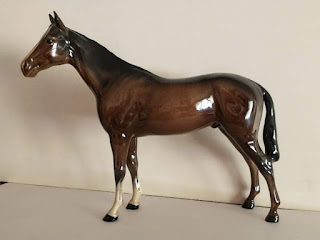
Above: Plucky Liege. Below: A collectible ceramic statue of her son Bois Roussel, 
manufactured by Royal Doulton (courtesy of Susan Daigle-Leach).


Baron Michelham’s widow married Fred in February 1926 in Clearwater, Florida; she was 43, and he was 38. Within months she became ill, and she died the following January, “leaving the bulk of her fortune, estimated at $50 million, to Mr. Almy. In the inheritance was said to have been a palatial house in Paris, which Lord Michelham had lent to Prime Minister David Lloyd George as his residence and British headquarters during the 1919 Peace Conference” (New York Times, 2 January 1927).

Not long after his first wife’s death, Fred received an invitation to a fashion show from a French salon that she had often patronized, and he decided to attend the event by himself. There, he met a 20-year-old British model named June Dibble. They were married the following month in Paris and began spending their way through the Michelham fortune. The media dubbed Fred the “Cowboy Millionaire,” and for a number of years, everything he and his new bride did seemed to make the papers. 

Fred, however, hadn’t forgotten his Arizona friends. A newspaper article from January 1927, only weeks before his second marriage, noted that Fred had shipped two purebred Arabian stallions from Europe to General Levi Manning, onetime mayor of Tucson, Arizona, credited as the first breeder of purebred Arabian horses in the state. The headline read: “Fred Alma [sic] Coming from Abroad With Papers of Pedigree for Manning’s New Arabian Horses—‘Finest Ever Seen’” (Tucson Citizen, 19 January 1927). (Unfortunately, the names of these two horses are not known.) By this time, Manning already owned the Arabian stallions El Jafil (*Ibn Mahruss x Sheba), Jarad (Ziki x Tamarisk), Kalub (Ziki x Hasiker), and Saraband (Harara x Sedjur), all of which he had acquired from California with the help of a man named Hamilton Bassett, a self-proclaimed horse authority whose British-born wife passed herself off as “Lady” Betty Bassett. (One article about the couple noted incorrectly that Hamilton was “the first man to penetrate into [Tibet]” and that “Lady” Betty was the daughter of “Sir Joseph Grice-Emerson, and is a noted adventuress and explorer” (Republican-Gazette [Gove City, Kansas], 26 August 1915).

Fred and June began buying vast tracts of land in Arizona, including a 30-acre parcel in what is now metropolitan Phoenix, southwest of the intersection of Seventh and Maryland Avenues. While Fred purchased cattle, cars, and several Kentucky-bred racehorses, June became part of Phoenix’s social scene, showed horses, and even rode some of her husband’s racehorses at the Phoenix fairgrounds track. 

By this time, Fred had become so well known across the U.S. that someone named a racehorse after him. Born in 1929, the equine Fred Almy (Jack Hare Jr–Eleanor S., by Ivan The Terrible), owned by Cora Polk, ran for nine seasons, started a whopping 194 times, and won 27, including the 1931 Juvenile Handicap at Agua Caliente, in Tijuana, Mexico—where the “Millionaire Cowboy” also ran his own racehorses. (Presumably, the human Fred Almy was aware of his namesake, but it’s not known what he thought of him.)

Things seemed to be going splendidly for the Almys. One Los Angeles reporter remarked, “Quite a character, this Almy. Known all over Arizona as the ‘Millionaire Cowboy.’ Owns about half the state of Arizona, his friends say, and the cattle roam far and free on his vast ranches” (Los Angeles Daily News, 4 February 1930). What Fred and June’s friends didn’t know, however, was that a large part of his fortune had been wiped out in the 1929 stock market crash. Within a couple of years, the thousands of acres the couple had purchased on credit went into receivership. 

It’s unclear when June and Fred began to drift apart. In 1936, newspapers across the nation ran stories (complete with a topless photo) about June’s affair with a handsome married stockbroker named Jerry Wheelock. One reporter wrote, in a line that sounds particularly ludicrous to horse people, that Mrs. Wheelock demanded “a court snaffle to curb the Dawn Patrol canters of her playboy mate” (New York Daily News, 21 February 1936). By this time, June was living in New York and running a high-end florist shop. In 1939, June filed for divorce but asked for no alimony, as she was well aware that Fred had no money to give her (Albuquerque Journal, 10 November 1940). In fact, Fred was so poor that he didn’t have sufficient funds to attend his mother’s funeral. (Mrs. Almy wouldn’t have wanted him there, anyway, as she had cut him out of her will.)

                                     Cartoon in the Tacoma News Tribune, 11 October 1940. 

As Fred’s adventures receded from the headlines, it was his ex-wife whose name was again on the ascendancy. June made the national news for the last time in early 1943 after reporters learned that she’d married a wealthy, divorced lumberman, Albert Stanwood “Stan” Murphy. When Stan’s former paramour—a washed-up actress named Madge Bellamy—heard the news, she became so enraged that she drove to Stan’s club on San Francisco’s Nob Hill, waited for him to exit, and then shot at him with her revolver, but missed. The Texas-born Bellamy, who later told reporters that she was a good shot and “could have hit him” if she’d really wanted to, found herself back in the limelight for the first time in decades.

Bellamy’s movie career had certainly had its highs and lows—early on, she’d appeared in two John Ford pictures, including The Iron Horse (1924), and she earned a star on the Hollywood Walk of Fame. However, as she grew more difficult to work with, the only parts she was offered were in lower-quality fare, such as 1932’s White Zombie (1932), starring Bela Lugosi. By the time she shot at Murphy, Bellamy hadn’t worked in pictures for six years. She never served time for her crime, and instead received a six-month suspended sentence for violating a gun law. Later in 1943, Bellamy sued Stan in Nevada, on the grounds that they had been married there in 1941. However, no evidence of their putative marriage ever came to light, and the case was dismissed. Stan reportedly gave her a six-figure settlement to get her out of his life. 

                                    Bela Lugosi and Madge Bellamy in White Zombie (1932). 

Stan had become acquainted with Fred Almy several years before either of them met June. The two men had visited Arizona back when both of them were bachelors. In fact, in the summer of 1915, Stan and Fred dined together twice at Riverside, an amusement park south of downtown Phoenix that featured a large swimming pool, a zoo, and live music (Arizona Republic, 16 May and 20 June 1915). Stan married his first wife in 1917, and although the couple lived in California, they periodically visited Phoenix, where June and Stan likely became acquainted. As the San Francisco Chronicle noted, “No whirlwind romance was theirs, Stan and June having met some years ago when both had marital commitments” (10 January 1943).

The Murphys’ marriage appears to have been happier, and considerably more sedate, than their previous relationships. After 20 years of marriage to June, Stan died in April 1963 at age 70. Two years later, Fred Almy—who had eked out a living by hauling other people’s racehorses from track to track—died in his room at a seedy hotel near Hell’s Kitchen in New York. He was 77. For the next two decades, June lived quietly, never remarried, and passed away in San Francisco in 1986. 

Three years after Fred Almy’s death, a chestnut filly was born on Frank Brophy’s 30,000-acre Babacomari Ranch in southern Arizona. Her sire, the stakes-winning Whodunit, stood at Claiborne Farm and was, like Secretariat, a grandson of *Princequillo. The filly’s dam, Flower Pot, a daughter of Delphinium, had been bred and raised by Brophy. By that time, Brophy had been breeding and racing Thoroughbreds in Arizona and California for four decades, had served on the board of the Arizona Racing Commission, and had been dubbed “the patriarch of Arizona racing.” There’s no indication that Brophy had kept in touch with June (Almy) Murphy since the 1930s. However, something about this particular filly clearly reminded him of the beautiful young model who, with her husband Fred, the onetime “Cowboy Millionaire,” kept Arizona residents—and the nation—riveted during the Depression as they blew through $50 million in track record time.

                                                           June Almy (b. 1903, d. 1986).


Monday, June 29, 2020

What the Butler Saw: Or, What Do McDonald’s, Auntie Mame, Class Rings, and Arabian Horses Have in Common?


By Tobi Lopez Taylor


A Story in Three Parts

Part One: Daniel C. Gainey
In 1940, Daniel C. Gainey—chairman, CEO, and guiding force behind Jostens, Inc., the nation’s leading maker of class rings, received an unusual gift from his employees: an Arabian colt named Kaniht (Katar x Niht). 

Kaniht, bred by Albert Harris, scion of the family that established Chicago’s Harris Bank, descended primarily from horses bred by Wilfrid and Lady Anne Blunt of England’s Crabbet Stud. (You can read more about the Blunts here, here, and here.) Kaniht was also something of a rarity in the U.S., as only about 1,700 Arabians had been registered in this country since the founding in 1908 of the Arabian Horse Registry of America (AHRA; now known as the Arabian Horse Association). When Gainey acquired Kaniht, Harris was the AHRAs president; many years later, Gainey would hold the same position.


Ferzon and his son Gai Parada. Photo by Sparagowski.

Now smitten with the breed, Gainey soon began acquiring Arabians with the goal of establishing his own breeding program in Owatonna, Minnesota. Unlike Harris, who prized Arabians for their toughness and athleticism, Gainey valued beauty, elegance, and refinement.  Over the decades, as he bred hundreds of Arabians, he created the “Gainey look”—horses with large eyes, “teacup” muzzles, and well-sculpted ears—based on the bloodlines of his herd sire, Ferzon (Ferneyn x Fersara). His program was quite successful in the show ring: three products of his program, Galizon (Azraff x Gay Rose by Ferzon), Gai Parada (Ferzon x Azleta by Azraff), and Gai-Adventure (*Naborr x Gavrelle by Ferzon), were all U.S. National Champion Stallions. Gainey first kept his Arabians exclusively in his home state of Minnesota, but later branched out, with ranches in Scottsdale, Arizona, and Santa Ynez, California.


Gainey Ranch, Santa Ynez.


Part Two: Pat Tanner / Patrick Dennis / Edward(s) Tanner

If you’ve seen the 1958 movie Auntie Mame—which recounts the adventures of Mame Dennis and her nephew Patrick—you may have noticed that it’s based on a book by Patrick Dennis. However, “Patrick Dennis” was actually a pseudonym used by the flamboyant writer and bon vivant Edward Everett Tanner (known to friends and family as Pat).  A 2000 biography of Tanner/Dennis, Uncle Mame, by Eric Myers, makes for fascinating reading about this formerly celebrated, but now nearly forgotten, author who once had three books on the bestseller list simultaneously.


As Myers noted, “People assume that [Auntie Mame] is based on fact—that young Patrick really was raised by a madcap New York aunt—when in reality, he grew up rather conventionally as part of an upper-middle-class family....Once he left those confines, however, he led a life as unusual—and as poignant—as that of any fictional character he could have created. Auntie Mame was only one of Tanner’s sixteen novels. The book made him a millionaire and has earned its place as a perennial pop classic of American fiction.” Unfortunately, “[a]lthough both Tanner and his books were uproariously funny, and he was beloved by those close to him, his life was marked by an underpinning of frustration and melancholy.”


In 1963, at his professional and personal wit’s end, Tanner separated amicably from his wife and acknowledged that he was bisexual. Literary tastes were changing, and his light-comic prose, which had delighted so many readers in the 1950s, was now out of step with the turbulent 1960s. Tanner knew he had to do something else to make money. “He had sworn off writing,” remarked Myers, “but he was about to embark on the sort of escapade that could easily have provided material for five more novels.”

After living in Mexico, and then a stint as a gallery owner, Tanner decided to become a butler. As Myers noted, “He was already intimate with every detail that went into running a fine home; he loved to arrange lavish dinners and parties; he certainly had the grace, elegance, and tact—when he wasn’t sloshed—that were required for the job. Add to this his precise knowledge of cuisine, clothing, and decor, and you have a majordomo worthy of the White House....And best of all, it would be fun. Pat would be living inside one of his own novels, simultaneously observing and interacting with the class of people he had satirized.”

For his new profession, Tanner renamed himself “Edwards Tanner,” which made him sound like a character from one of his books. None of his employers knew that their butler was the creator of Auntie Mame. In early 1976, Tanner, by now an experienced butler, went to work for McDonald’s president Ray Kroc and his wife Joan at their apartment on Chicago’s Lakeshore Drive. In a letter to his son, Tanner drew a portrait of the couple:

“Mr. and Mrs. Ray Kroc … are the dearest people on earth—nouveau riche (20 years of super affluence) and frank to admit it. If anyone has to be burdened with several hundred million dollars, it ought to be the Krocs. Far from being ashamed of their money, they revel in it. They have a place in Florida, a ranch in California, and this posh apartment in Chicago where they occupy the whole twenty-fifth floor and I simply pig it on half of the twenty-sixth, all exquisitely overdecorated and quite good in a terrible way. They revel in their yacht, their jet, their helicopter, their private railway car, their baseball team (the San Diego Padres, who have never been known to win a game), their Cork Foundation (guess what that is spelled backward) to combat alcoholism, their 15 cars (only three of which are Rolls-Royces) and their Arabian horses (neither rides)….Well, I just couldn’t have fallen into a better place or with nicer people.”


Part Three: Ray Kroc

The son of Czech immigrants, Ray Kroc grew up near Chicago. He served as a Red Cross ambulance driver during World War I and then worked at a variety of low-wage jobs. (Although Kroc never knew this, Tanner also had been an ambulance driver—for the American Field Service, during World War II.) Kroc’s New York Times obituary called him a “former piano player and salesman of paper cups and milkshake machines.” He was in his mid-fifties when he opened his first McDonald’s franchise, and in 1961, he bought out the original owners, Maurice and Richard McDonald. By 1965, when McDonald’s stock was initially publicly traded, Kroc’s shares were worth $33 million. Not long after that, Kroc and his then wife Jane (who had been John Wayne’s secretary) purchased more than 200 acres in the Santa Ynez Valley, about 35 miles northwest of Santa Barbara, California, for $600,000 and named it the “J & R Double Arch Ranch.” The three flagpoles at the property featured the American flag, the California state flag, and a flag with golden arches. 


Sculpture by King Zimmerman at the Krocs ranch. Photo by Danforth-Tidmarsh.

The ranch was the focus of a 1968 article in Architectural Digest. Its 17,000-square-foot main lodge served as living quarters for the Krocs, a meeting room for McDonald’s executives, and the headquarters of the Ray A. Kroc Foundation. (Later, a round house, which reminded some observers of a hamburger, was built on the property for the Krocsexclusive use.) The article noted that the property “has more comforts and conveniences than most city dwellings and at the same time offers the invigorating atmosphere of the outdoors and sporting life.” In addition, “for the recreation of guests, there is horseback riding” and “parts of the ranch are productive work areas, involved with horse breeding and training and the raising of cattle.” 

No mention was made of a horse barn, but the cattle barn was innovative for its time: it was air-conditioned and featured “automatic sanitation facilities” and music for the cattle; Architectural Digest called it “one of the most elaborate [cattle operations] in the country.” Noted Arabian horse judge Judy Delongpré Kibler, who lived in the area, remembered that the barn “was a bit over the top from the standpoint that [the cows] stayed in this building, which had a flushing system and feeding system. Way too expensive to raise cattle that way—I believe it was used for maybe a year or two.”

It was also around this time that Ray Kroc began buying horses from Daniel Gainey, now president of the AHRA. It’s unclear exactly how Kroc and Gainey met, but they had a number of things in common, aside from owning ranches in Santa Ynez. Both of them were Midwesterners who had joined already-existing companies, (McDonald’s and Jostens), reconfigured them, and guided the organizations to unprecedented success. Both of them were also staunch Republicans who hated FDR’s New Deal. 

Gainey was campaign manager for Harold Stassen’s 1948 and 1952 presidential bids, served as Barry Goldwater’s finance chair for his 1964 presidential run, and was a longtime friend and advisor of President Richard Nixon. Kroc made his only known foray into politics when he donated $255,000 to Nixon’s re-election campaign (this would be $1.6 million today). The donation was made during the time that Kroc was doing horse business with Gainey, so perhaps the latter suggested or facilitated it. (Nixon, too, had a connection to Arabian horses via Gainey; his daughters Tricia and Julie learned to ride on the mare Gali-Ferra (Ferzon x Gali-Rose), who had been a gift from Gainey to President Dwight Eisenhower.)


Goldwater and Gainey, 1964. 


In 1967, while the 
Krocs’ Santa Ynez property was being constructed, Ray became the owner of his first Arabian, bred by Gainey. Kroc’s new acquisition was the 1966 colt Gi-Frisco, out of one of Gainey’s excellent broodmares and by the stallion El Kumait, owned by another local breeder, Frisco Mari. Since Gi-Frisco was only a yearling when Kroc acquired him (and thus couldn’t be ridden for a few years), perhaps he was a gift from Gainey—just as Kaniht had been a gift to him from Jostens employees in 1940. (Notably, this colt was the only horse of the hundreds bred by Gainey whose name carried a “Gi” prefix. The names of Gainey’s other horses featured the “Gai” or “Ga” prefix—suggesting that this may have been a spelling error on the part of whoever filled out the colt’s registration papers.)

Gi-Frisco’s sire El Kumait had been foaled in 1935 at cereal magnate W. K. Kellogg’s ranch in Pomona, California. Arabian breed historian Gladys Brown Edwards wrote that El Kumait “was injured on one leg as a yearling, causing permanent damage to the leg. Since it was not certain whether he would outgrow this deformity he was sold as a two-year-old, but otherwise it is doubtful if this splendid stallion would have left the ranch.” His descendants include race winners, like Speed King and Fercheyn, and numerous National winners, such as RSR Kumait, U.S. Top Ten English Pleasure and Pleasure Driving, and Speed Princess, with five National titles to her credit, including U.S. National Champion Futurity Cutting Horse. 

Gi-Frisco’s dam Galata was by Ferneyn (sire of Ferzon) and out of Gainey’s best-producing mare, Gajala (*Raffles x Rageyma). Galata’s descendants include Gurisha Ferzona++ (dam of Kaborray, U.S. Top Ten Gelding), Gai Rainbow++ (sire of Gai Beauseyn, U.S. Top Ten Jumper), and Galatia (dam of GA Amir Amage++, U.S. Reserve Champion Western Pleasure, as well as granddam of Grand Jazz, twice U.S. Top Ten English Pleasure Amateur Owner to Ride, 18 & over). 


Gubla, dam of three foals for Ray Kroc. 


Kroc made more purchases from Gainey in 1968. These were the 1960 mare Gubla (*Royal Diamond x Ghuli), her 1968 filly Ferbla (by Ferzon), and the foal that Gubla was carrying, the colt Galizon Prince (by Galizon), born in 1969. Judy Delongpré Kibler and her then husband Don DeLongpré managed the Gainey Ranch in Santa Ynez back then and delivered the horses to Kroc’s place. Ray’s new mare Gubla was by *Royal Diamond (Oran x Grey Royal), who had been bred in England by Judith Blunt-Lytton, Lady Wentworth (daughter of the previously mentioned Wilfrid and Lady Anne Blunt), and imported to the U.S. in 1957 by Bazy Tankersley of Al-Marah Arabians, then in Maryland. Tankersley recalled that *Royal Diamond “was a spectacular creature, but I wasn’t very happy with his disposition, nor did he have the exceptional hindquarters mandatory for Al-Marah breeding stock.” Other breeders, including Gainey, bred to him multiple times with good results. Among *Royal Diamond’s well-known descendants were stakes winner Charlie Valentine, 1988 Darley Horse of the Year; Ibn Raffon++, U.S. and Canadian Top Ten Stallion; and Royal Mace, U.S. National Champion Western Pleasure Amateur Owner to Ride.


Galizon, sire of Krocs colt Galizon Prince. Photo by Johnston.


Ghuli, Gubla’s dam, bred by James and Edna Draper, was of mostly Crabbet breeding. She was a full sister to Sur-Ghari, U.S. Top Ten Stallion. Ghuli’s sire, Sureyn (*Raseyn x *Crabbet Sura), was linebred to Lady Wentworth’s influential Polish stallion Skowronek, and Ghuli’s dam, Gharisa (Gharis x Mona Lisa), had bloodlines from Spain, the Davenport importations, and Crabbet Stud. Sureyn was a notable sire of champions, including the first U.S. National Champion Stallion and Mare, Mujahid and Surita. A half-sister to Gubla, named Gata (by Ferzon), foaled Nigatt, U.S. Top Ten Native Costume and sire of four National winners. 

Prior to her purchase by Kroc, Gubla produced Gublazon (by Ferzon), who is best known as the paternal grandsire of U.S. National Champion Stallion Arn-ett Perlane. Gublazona, her second foal, was a good broodmare for Arcadian Arabians of Pennsylvania; Gublazona’s daughter Arkdn Gublaziona (by *Cebion) was an early winner of the Legion of Supreme Merit. 

In 1969, Ray Kroc divorced his wife Jane. Within days, he and Joan (née Mansfield) Smith—the recently divorced wife of McDonald’s franchisee Rollie Smith—married in front of the 28-foot-tall fireplace at the J&R Double Arch Ranch. 

In 1972, Gubla was taken back to Gainey Ranch to be bred to Gai Warsaw (Ferzon x *Paleta), producing the 1973 filly Gai Easter. Gai Warsaw, a sire of champions in the U.S. and U.K., was the grandsire of Gai Radiant, U.S. and Canadian Top Ten Western Pleasure Junior Horse, who was purchased in 1997 by Shirley and Charlie Watts (of Rolling Stones fame) for their Halsdon Stud in England.  Gai Easter was Gubla’s last foal. 


Gai Warsaw, sire of Gai Easter, bred by Kroc. Photo by Sparagowski.

Kroc bred Ferbla (a full sister to Gublazon and Gublazona) twice. The first time, she was bred to Khari (Khemosabi x Carinosa), Canadian National Champion Stallion, who was trained and shown by Don Delongpré. The resulting colt, born in 1974, was named Padre Khari, presumably in honor of Kroc’s having purchased the San Diego Padres baseball team in January of that year. 


Above: Khari, sire of Padre Khari; Below: *Eter, sire of Corky. 
Photos by Sparagowski.

Three years elapsed before Ferbla produced another foal, this time by the Polish stallion *Eter (Comet x Estokada), Don DeLongpre’s well-known sire of National winners, who was standing at nearby Caravan Arabians. Ferbla’s 1977 colt—named Corky—was the last of Kroc’s breeding experiments. Corky’s name was likely a nod to Operation Cork, a foundation established by Joan Kroc to combat the effects of alcoholism on families. The foundation produced public service announcements, including animated spots featuring Corky, the talking cork. (After her husband’s death, Joan Kroc admitted that Ray’s drinking was the impetus for establishing the Cork Foundation.) Author Lisa Napoli has written an engrossing biography of the couple in Ray & Joan: The Man Who Made the McDonald’s Fortune and the Woman Who Gave It All Away. )


Corky the talking cork.

Kroc’s  seven Arabians were all of excellent Gainey Ranch bloodlines. None of the horses appear to have been shown, only two (Gubla and Ferbla) produced offspring, and only one (Galizon Prince) is known to have been sold by him, according to the Arabian Horse Association. As Judy DeLongpré Kibler noted, Kroc “really never intended—in my recollection—to be a breeder, [and] the horses probably lived out their lives on his ranch.” 

Daniel Gainey passed away in 1979, and his Santa Ynez ranch now features a winery run by his grandson. Ray Kroc died in 1984. His widow sold the J&R Double Arch Ranch—the birthplace of the Egg McMuffin and McNuggets—to, of all people, a health-supplement magnate, Gerald Kessler, who converted the ranch’s test kitchen into a fitness center. If only Pat Tanner—who died in 1976—had been around to witness this. What a novel he could have written! 


Sign outside the former J&R Double Arch Ranch.
Photo by Lisa Napoli (cropped from original). 


x

Wednesday, April 15, 2020

Living Soil, Living Art: Eve Balfour, Her Arab Mare Bendira, and New Bells Farm

By Tobi Lopez Taylor


This post is part of the ongoing Crabbet Chronicles series, which also includes Lady Anne Blunt’s Stradivarius and Wilfrid Blunt’s meeting with Lawrence of Arabia.

In 2018, Prince Charles sent his “warmest congratulations” to the UK’s Arab Horse Society (AHS) on its hundredth anniversary, writing, “As the proud owner of four very beautiful Arabian horses, I have come to appreciate this particularly special breed....For one hundred years The Arab Horse Society has devoted itself to promoting interest in Arabian horses in the United Kingdom.” The AHS’s first president was Wilfrid Scawen Blunt, who, with his wife Lady Anne Blunt, established the world-renowned Crabbet Stud in Sussex.

Eve Balfour, “the Compost Queen,” and her draft horses (from Brander 2003).


The previous year, Prince Charles had celebrated the seventieth anniversary of the Soil Association, “the UK’s leading food and farming charity, and organic certification body,” whose motto is “healthy soil, healthy people, healthy planet.” While at the association’s annual luncheon, he lamented the fact that he had never met its founder, Lady Eve Balfour, OBE (1898–1990), nicknamed “the Compost Queen” for her efforts to inculcate organic farming in the UK. In addition to obtaining a degree in agriculture (at a time when few women were college graduates) and writing the literally groundbreaking book The Living Soil, Eve was an early member of the AHS and owned a mare named Bendira—a daughter of the Blunts’ famous stallion Mesaoud, whom they had imported from Egypt to their Crabbet Stud in 1891.

Eve Balfour in the 1940s (photo credit: Wikipedia).


Born in 1898, Eve was the niece of Arthur James Balfour, who later became British prime minister; she called him “Nunkie.” Her mother was the daughter of a viceroy of India, a granddaughter of prolific author Edward Bulwer-Lytton (of “It was a dark and stormy night” fame), and a sister of Neville Lytton, third Earl of Lytton, who was an artist, an Olympic medalist, and son-in-law of the Blunts. His wife, Judith Blunt-Lytton, is known to Arabian horse fanciers as the breeder and author Lady Wentworth.

Drawing of Eve by her uncle, Neville Lytton (from Brander 2003).


From a young age, Eve knew she wanted to be a farmer. She was fortunate to be born into an eccentric, passionate family. A number of her Balfour relations were early members of the Society for Psychical Research (SPR) (her uncle by marriage, Henry Sidgwick, was the SPR’s first president), and her aunt, Constance Lytton, was a suffragette who was jailed four times. As Eve’s biographer noted in 2003, “It must have required a strong personality and an equally strong voice to hold one’s own in the often animated family discussion….Nor were such discussions restricted to the male side of the family.”

Fishers Hill, Eve’s childhood home (photo credit: The Lutyens Trust). 


The house in which Eve grew up—Fishers Hill, in Surrey—had been designed by the well-known architect, Sir Edwin Lutyens, whose wife, Lady Emily (Lytton)Lutyens, was Eve’s aunt. (Lady Emily became a Theosophist and went on to become a follower of Krishnamurti.) The architect’s biographer (and descendant), Jane Ridley, wrote that Eve’s mother, Betty, “was unworldly and helpless in practical matters. She shocked [Lutyens] by travelling in dirty third-class carriages with her children, none of whom ‘looked as if any care, thought or trouble was taken with their appearance, either clothes or body.’ For a family of intelligent, tomboyish, and rather neglected girls, Fishers Hill was a paradise; it [was] ideally suited to games and outdoor theatricals. Betty’s grandchild Anne Balfour remembered it as a magical house, with the feel of Kipling and Puck of Pook’s Hill.”

The teenage Eve working  with a pony (from Brander 2003).


As a youngster, Eve was often on horseback, and had numerous cats, dogs, and other animals. She became a vegetarian at a young age and also took a great interest in plant growth, encouraged by her mother and her aunt, both excellent gardeners. Whereas in a typical family of her socioeconomic class, she would have been expected to “marry well” and raise children,  her biographer wrote that it was “an example of the advanced approach to parenthood of both her mother and her father that when she announced her wish to become a farmer…she was promptly entered for the Agriculture Department of Reading University College.”

Eve’s biographer also recounted that while Eve was in college, she “was closely in touch with her Lytton relations at Crabbet Park. Judith Wentworth, her [aunt by marriage], was to become the noted Arab horse breeder. Eve, of course was greatly interested in her work and enjoyed vising her. She even contemplated leasing one of the Crabbet Park farms in Sussex and went as far as discussing the possibility with Judith. At this stage her inclinations were strongly towards eventually taking a farm in Sussex.”

However, after Eve’s graduation, she and her sister Mary instead found a 157-acre, dilapidated farm in Suffolk named New Bells. There, the two of them and an assortment of friends, relatives, and, eventually, employees, worked twelve-hours days in an attempt to make New Bells a profitable concern. Her biographer noted, “Despite the fact that there was no running water or electricity, and sanitation was primitive in the extreme, everyone seems to have enjoyed themselves in this youthful household and contributed their assistance to the farm, whether feeding pigs, herding sheep, milking, or harvesting.” Eve’s cousin Betty Lutyens remembered her first visit to New Bells, “when she was greeted at the door by Eve...in breeches and a red spotted handkerchief.”


In 1939, after working at New Bells for two decades, Eve and her associates began the well-known Haughley Experiment at New Bells and a nearby farm. This study compared organic and chemically fertilized farming methods. As Kevin Desmond wrote, “Balfour published the initial results of her experiment in a book called The Living Soil where she presented the case for an alternative, more sustainable approach to agriculture. Its influence was such that, in 1946, Balfour co-founded and became first president of the Soil Association. While continuing the Haughley [E]xperiment for the next 25 years, the Association has developed into an international organization pioneered by Balfour. [She] continued to farm, write and lecture for the rest of her life.”

Eve’s “Lytton relations” at Crabbet Stud had sold her the well-bred Arabian mare, Bendira, around 1909. Bendira’s sire, the aforementioned Mesaoud, was one of the world’s most influential stallions, appearing (often multiple times) in the pedigrees of upwards of 90 percent of today’s Arabians.


Mesaoud (Aziz x Yamamah III).


Bendira’s dam, *Bushra, was bred by the Blunts. She stood only 14 hands. Arabian historian Carol Mulder noted that though she was a bit “long and low” through the body, in some photos “she could look very beautiful.” *Bushra was purchased by Charles Husted and imported to the US in 1900. Of her nine foals, only *Ibn Mahruss and Sira have living descendants.


*Bushra (Azrek x Bozra) (from Mulder 1991).


Bendira made a cameo appearance in the journals of Lady Anne Blunt, who recorded on June 3, 1903 that Prince Scherbatoff had come to tour Crabbet Stud and that her husband “took the Prince in the road cart with Bendira to see the mares and fillies….” Some years earlier, Scherbatoff and his brother-in-law Count Stroganov had established the Stroganov Stud near Tersk, in the northern Caucasus, where they bred Arabians. In 1899, the two men had visited Crabbet and had seen Bendira’s sire Mesaoud. In their book on Arabians, published in Russia the following year, Scherbatoff and Stroganov wrote that Mesaoud was “Crabbet Park’s number-one sire. He is a splendid specimen of a first-class Arabian and has won many prizes in England.” In 1903, Scherbatoff came back to Crabbet to look for more horses. Within weeks of Scherbatoff’s ride with Wilfrid Blunt driving Bendira, Mesaoud was purchased by a Polish breeder, Wladislaw Klineiwski, and appears to have changed hands again rather quickly, as he soon took up residence at the Stroganov Stud.


*Berk (from Covey 1982).


Bendira was closely related to the Crabbet-bred stallion *Berk, whose descendants often had excellent movement. *Berk was by Seyal, a son of Mesaoud, and out of Bukra, a three-quarter sister to Bendira’s dam *Bushra. (I wrote about *Berk’s daughter Tahdik and granddaughter Santa Fe, maternal ancestors of *Marwan Al Shaqab, for  Arabian Horse Life Magazine in 2019.)

Bendira was registered initially in the UK’s General Studbook (GSB). In 1906, it was noted that she had been bred to Narkise but came up barren. The 1909 GSB recorded the birth of Bendira’s “only produce to live,” a filly named Beneyeh (by Feysul)—suggesting that if Bendira had previous offspring, it or they had died before registration. Beneyah herself was never assigned a registration number, which presumably means that she did not survive for very long. Bendira was not re-bred in 1908, and after that was sold to Eve.

In 1920, a periodical called The Near East featured the following notice: “A council meeting of the Arab Horse Society was recently held at the Grosvenor Hotel, S.W., where entries for the Stud Book Vol. II and for the Arab-bred Register were accepted.” “Miss Eve B. Balfour, of New Bells Farm,” was listed as one of the new members, and Bendira, now twenty years old, was given AHS registration number 172. She was described as a chestnut mare with a blaze and three white socks, her color and markings similar to those of her sire.

Eve did do some horse breeding at New Bells, but her biographer, Michael Brander (Eve’s nephew by marriage), did not discuss about this aspect of her farming in any detail, other than to reproduce a letter from Eve’s mother in which she wrote that “the horse dealer who brought the stallion to Eve’s mares nearly had a fit when he found the New Bells farmer was a young girl. He’ll get accustomed to that....” Whether Bendira may have produced some part-Arabian foals for Eve is unknown, though possible, since one of the reasons for establishing the AHS was “to encourage the re-introduction of Arab blood into English Light Horse breeding.”

The same letter from Eve’s mother also mentioned seeing Eve’s fellow farmer, her sister Mary, driving a pony named Betty who “just gets in between the shafts and goes a jolly pace.” Is it possible that the “pony” Betty was actually Bendira, an experienced driving mare who could have inherited her dam’s small size? We likely will never know, but it’s charming to imagine Bendira, a flashy chestnut daughter of the great Mesaoud, trotting along at “a jolly pace” at New Bells Farm.