By Tobi Lopez Taylor
This essay is part of the ongoing Arizona Horse History Project series, which also includes posts on Penny Chenery and Secretariat, Hank the Cowdog, Man O’ War’s son By Hisself, Frank Brophy, Doc Pardee, and another essay about General Burton.
About two months ago, a woman and a man came walking up my
driveway on a Saturday morning. I had two horses turned out in the
arena. Often, people drop by to watch the horses romp or to ask whether I
board horses (I don’t), or inquire if I know where they can buy a pony for
their child (ditto) or a quarter horse for their husband (also ditto). I have
sport horses, equines bred to event, do dressage, or jump—and that kind of
thing is rare on my side of Tucson, where the majority of riders I know either
rope or trail ride.
But back to the couple. The woman said they lived nearby and
stopped because they’d seen dressage letters in my arena. She inquired about
whether I rode dressage (yes), and did I have a trainer (yes), and then she
said, “My father, here, is a horse trainer. His name is Jack Burton.”
I couldn’t believe it. “You’re not Major-General Jonathan
Burton, are you?
The man nodded, and his eyes lit up.
“It’s an honor to meet you, sir.”
General Burton is a legend in the horse world: a member of the 1956
Olympic three-day event team, past president of various equestrian federations,
international judge, and author. Not long after I’d begun to take dressage
lessons, in the 1980s, a friend had given me Burton’s book How to Ride
a Winning Dressage Test. And Burton is still judging: I recalled that
he’d given a wonderful score to a Trakehner colt named Horatio SF, bred by my friend Heather Buttrum
Jantzen, in an in-hand class at a show in California a couple
of years earlier.


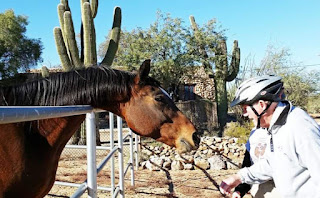
Burton, who is closer to ninety than he is to eighty, rides his
bike several days a week. Ever since our first meeting, he’s dropped by a
number of times to pet whichever horse of ours is turned out near the road,
usually Rosie, my Arabian mare. He doesn’t say much but seems quite glad to
simply be around horses on a somewhat regular basis.
The General unintentionally made my day on the Saturday after Thanksgiving. My husband and I were in the arena with Immaginn, my two-year-old Anglo-Arabian gelding, whose nickname, like the General’s, is Jack. This gelding is a product of our small breeding program, and he is by far the best one. I find very little to fault in him, but I'm well aware of that scourge of horse breeding, “barn blindness.” As it happened, General was passing by on his daily bike ride. When he got to our driveway, he pulled in and stopped. “Who is THAT?” he exclaimed, as Jack trotted around. “He’s magnificent!”
My husband looked at me and rolled his eyes, knowing he’d never hear the end of that remark.
“Can I quote you on that?” I asked.
“Sure!” The General watched Jack walk, trot, canter, and play
for about fifteen minutes. I asked him if he thought he saw a particular
discipline—dressage, jumping?—in his future. “The sky’s the limit with that
one,” he replied, and then he pedaled on home. I have been smiling ever since,
and am now calling Jack (the gelding, not the General) “Mr. Magnificent.”

Interestingly, what the General didn’t know was that he himself had seen the sire of this gelding. Jack’s dad is a stallion named Innkeeper, one of the last remaining sons of the famous Secretariat, and the only one licensed for warmblood breeding. Innkeeper’s owner, Ursula Ferrier, and I are friends. A while back, she wrote, “Hilltop Farm asked if we could bring [Innkeeper] to a breed judges’ seminar with the head of the Swedish National Stud at their farm. He was a big hit...and Major General Jonathon Burton thought he was the only ‘real’ stallion there.” Imagine—or rather, Immaginn—that!


