Monday, November 29, 2010

General Burton’s Final Ride, on a Mare Named Brusally Panatela

By Tobi Lopez Taylor


This essay is part of the ongoing Arizona Horse History Project series, which also includes posts on Penny Chenery and Secretariat, Hank the Cowdog, Man O’ War’s son By Hisself, Frank Brophy, Doc Pardee, and another essay on General Burton.

The day after Thanksgiving last year, I was riding my Arabian mare Rosie in the arena at the front of the property when our local Olympian, Major-General Jonathan R. Burton, came pedaling over his bicycle, along with his daughter Judy and son-in-law Don (you can read more about our neighbor, the General, here). Rosie marched over to the fence so that her friend the General could rub her face, and we all compared notes on our respective Thanksgiving dinners. Then Judy looked down at Rosie and up at me, and said, "Dad hasn't ridden for years, but he wants to ride a horse."

I had visions of lightning-quick Rosie becoming famous for doing a double-axel and breaking the General's 90-year-old hip—or worse. There would be headlines about it in the Chronicle of the Horse, the USCTA News, and Dressage Today. Rosie and I would have to change our names and move to an undisclosed location to avoid angry mobs. I shook my head. "I don't think this is the horse for you," I told him. "But my chestnut mare is a retired FEI horse, and I think she'll suit you just fine."

 "Great," said Judy. "How's tomorrow morning sound, about 10 a.m.?"

 "I'll have her all saddled up," I answered.

 I spent the rest of the day cleaning tack and tidying up the General's mount, Brusally Panatela. Retired from showing since 2005, she was a 24-year-old Arabian/Trakehner mare, bred, raised, and started under saddle by my friend and mentor Shelley Groom Trevor. Panatela's sire, Brusally Orzetyn, a son of  Orzel, "the Arabian Secretariat," had been one of a handful of horses in the early 1980s in Arizona competing at Prix St. Georges in dressage.

Panatela herself had shown successfully to Fourth Level in dressage and could perform many of the FEI movements. However, in order to compete at the upper levels, she needed to wear a double bridle, and she'd never met a curb/snaffle combination that suited her. That was irrelevant for the General's ride; she would go well enough for him in a snaffle, though she was a little creaky these days. I gave her a dose of Bute to make the upcoming ride easier on her.

The next morning, I fed horses, mucked stalls, and counted the minutes until I could tack up Panatela. As I worked, I recalled the first time I sat on her, in 1989, when she was four years old. I recalled when she was sold to her longtime owner Carla Ferrara, and how delighted I was to buy Panatela from Carla in 2000. Panatela had been ridden by two Grand Prix riders (Beverly Rogers and Julie Sodowsky), and now she was going to be ridden by an Olympian. I prayed she'd go well for the General and that he'd enjoy himself and be safe.

Brusally Panatela, ridden by Jeannette Schaeffer, wins her Third Level class 
at the CARA Champagne Show in the early 1990s.

Then I remembered Shelley telling me that Panatela’s sire—who we called “the smartest horse in Scottsdale”—had once carried an elderly horseman for one last ride: AndrĂ© Popiel (father of horsemen Andrew and Paul Popiel), a former Spanish Riding School equestrian. It had taken four people to get Mr. Popiel onto Orzetyn, who stood like a rock and then carried his rider as if he knew the gravity of the task. I prayed Panatela would go equally well for the General and that he'd enjoy himself and be safe.

 A little before the appointed time, the General and his daughter arrived. Camera in hand, my husband Alan came out to join in the fun. The General was attired in vintage riding gear, including a hard hat that I felt sure wouldn't pass the ASTM safety standards, and  well-used brown leather boots that fastened on the sides, like half-chaps, and resembled some expensive "distressed" footwear that Ralph Lauren had offered a few seasons before. And he was smiling more than I'd ever seen him—this despite not even having sat on Panatela.


I led Panatela up to the mounting block, telling her under my breath how important it was to "be a good girl today, and don't get anybody hurt."  Alan stood on Panatela's off side, pressing down on the stirrup, and Judy helped her father get aboard. It took him a minute to get organized, and then we all stepped back to watch.

General Burton competing in Wiesbaden, Germany in 1949.

Panatela has some arthritis in her hocks, and at the walk, her left hind leg takes a shorter step than her right. I was curious to see how many strides it would take the General to get her striding evenly behind. Answer: two strides—and then, not only were her strides evenly matched, they became longer. As the minutes went by, the 90-year-old rider and his 24-year-old mount were showing us the training scale in action: rhythm, suppleness, connection, impulsion, straightness, and collection.

The General on Brusally Panatela.

Alan and I looked at each other, across the span of the arena; over the years, we've gone to some pretty high-level dressage shows, including the World Cup. He's not an aficionado or a zealot (like his wife), but I could tell that he knew he was seeing something out of the ordinary. The General's position and technique were straight from a textbook, and his suppleness surprised me. Like the horsemen at the Spanish Riding School, he looked like he was doing nothing—and yet, paradoxically, his body was doing innumerable subtle, minute corrections with each stride that Panatela took. Soon he asked her for some slow sitting trot. When that was going well, he used his dressage whip just slightly to transition to a more stately, cadenced trot, known as a passage. Because passage is relatively difficult, especially for an older horse with hock issues, he halted her after a few minutes, and patted her neck. Everyone but the General had tears in their eyes. Then he said to his daughter, "Okay, I'm done. And I didn't fall off!" We helped him dismount, he fed Panatela a piece of carrot, and  I led her back to the barn.

Happy rider, happy horse, relieved owner. 

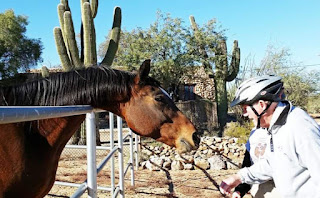
General Burton had simply asked to ride a horse again, but in so doing, he gave those of us who were present—including, if not especially, Panatela—an enormous gift: an expression of artistry, kindness, and joy. Often, when I am in my barn cleaning stalls, I'll see him, now age 91, riding his bike down the street. When he gets to our driveway, he slows down to see if there are horses in the arena (and there usually are). Then he rides over to the fence, and they soon come up to greet him—this man who loves all horses.

Monday, December 8, 2008

My Neighbor, the Olympian: Major-General Jonathan Burton, an Equestrian Legend

By Tobi Lopez Taylor

This essay is part of the ongoing Arizona Horse History Project series, which also includes posts on Penny Chenery and Secretariat, Hank the Cowdog, Man O’ War’s son By Hisself, Frank Brophy,  Doc Pardee, and another essay about General Burton.  

About two months ago, a woman and a man came walking up my driveway on a Saturday morning. I had two horses turned out in the arena. Often, people drop by to watch the horses romp or to ask whether I board horses (I don’t), or inquire if I know where they can buy a pony for their child (ditto) or a quarter horse for their husband (also ditto). I have sport horses, equines bred to event, do dressage, or jump—and that kind of thing is rare on my side of Tucson, where the majority of riders I know either rope or trail ride.

But back to the couple. The woman said they lived nearby and stopped because they’d seen dressage letters in my arena. She inquired about whether I rode dressage (yes), and did I have a trainer (yes), and then she said, “My father, here, is a horse trainer. His name is Jack Burton.”

I couldn’t believe it. “You’re not Major-General Jonathan Burton, are you?”

The man nodded, and his eyes lit up.

“It’s an honor to meet you, sir.”

General Burton is a legend in the horse world: a member of the 1956 Olympic three-day event team, past president of various equestrian federations, international judge, and author. Not long after I’d begun to take dressage lessons, in the 1980s, a friend had given me Burton’s book How to Ride a Winning Dressage Test. And Burton is still judging: I recalled that he’d given a wonderful score to a Trakehner colt named Horatio SF, bred by my friend Heather Buttrum Jantzen, in an in-hand class at a show in California a couple of years earlier.

At left: General Burton show jumping in 1949; at right, taking a fall on the Olympic cross-country course in Stockholm, 1956 (he remounted and finished the course). 

Burton, who is closer to ninety than he is to eighty, rides his bike several days a week. Ever since our first meeting, he’s dropped by a number of times to pet whichever horse of ours is turned out near the road, usually Rosie, my Arabian mare. He doesn’t say much but seems quite glad to simply be around horses on a somewhat regular basis.

The General unintentionally made my day on the Saturday after Thanksgiving. My husband and I were in the arena with Immaginn, my two-year-old Anglo-Arabian gelding, whose nickname, like the General’s, is Jack. This gelding is a product of our small breeding program, and he is by far the best one. I find very little to fault in him, but I'm well aware of that scourge of horse breeding, “barn blindness.” As it happened, General was passing by on his daily bike ride. When he got to our driveway, he pulled in and stopped. “Who is THAT?” he exclaimed, as Jack trotted around. “He’s magnificent!”

My husband looked at me and rolled his eyes, knowing he’d never hear the end of that remark.

“Can I quote you on that?” I asked.

“Sure!” The General watched Jack walk, trot, canter, and play for about fifteen minutes. I asked him if he thought he saw a particular discipline—dressage, jumping?—in his future. “The sky’s the limit with that one,” he replied, and then he pedaled on home. I have been smiling ever since, and am now calling Jack (the gelding, not the General) “Mr. Magnificent.”

General Burton and Immaginn: Jack and Jack.


Interestingly, what the General didn’t know was that he himself had seen the sire of this gelding. Jack’s dad is a stallion named Innkeeper, one of the last remaining sons of the famous Secretariat, and the only one licensed for warmblood breeding. Innkeeper’s owner, Ursula Ferrier, and I are friends. A while back, she wrote, “Hilltop Farm asked if we could bring [Innkeeper] to a breed judges’ seminar with the head of the Swedish National Stud at their farm. He was a big hit...and Major General Jonathon Burton thought he was the only ‘real’ stallion there.” Imagine—or rather, Immaginn—that!


Tuesday, October 10, 2006

Lucky Baldwin and the Cure for Boredom: Horses

 Recently, while proofreading Playing Cards of the Apaches: A Study in Cultural Adaptation, by Virginia and Harold Wayland, and Alan Ferg, I was struck by this passage, a quotation from playing-card scholar Sylvia Mann: “I happen to collect playing-cards as my way into history.” 

Intrigued, I consulted Mann’s book, All Cards on the Table, in which she writes that “a true collector, whatever the object of his particular interest, be it children’s comics or gold snuff boxes, touches a live element of history....I have acquired, through application and countless reference works and the talents of other collectors, some knowledge about a lot of subjects hitherto outside my interests.” 

In the case of Playing Cards of the Apaches, my own “way into history”—horses—has come in handy. In the book, the provenance of each pack of cards is traced in minute detail, whether the pack belonged to a captured Apache girl, or a U.S. Army soldier, or even Vincent Price.

When I proofread the pages devoted to a pack owned by Elias J. Baldwin, he was mentioned simply as the donor of a pack of cards—and not, as I knew from my crazy patchwork way of assimilating history through horses, as “Lucky” Baldwin, who constructed the first iteration of the racetrack now known as Santa Anita Park, where Seabiscuit won the Big ‘Cap in 1940. 

Lucky was also the father of Anita Baldwin, whose Arabian stallion, *Ibn Mahruss, sired El Jafil, purchased as a herd sire by General Levi Manning, former mayor of Tucson, where I live. Hearing this, the junior author (Ferg) kindly agreed to add some further biographical information about Baldwin. 

Anita Baldwin and *Ibn Mahruss, bred by the Crabbet Arabian Stud 
of Lady Anne and Wilfrid Blunt.

Given Baldwin's interest in gambling, it’s not a surprise that he owned a pack of Apache cards; aside from their use in gambling, he may also have appreciated them for their depictions of caballos, ridden by jaunty caballeros. 

I don’t consider myself a collector of horses (though some of my friends might disagree), but, like Mann, my interest in equines has led me to learn about (and what is perhaps more frightening, to retain knowledge of) subjects that seem, at first glance, to have no connection to horses, including: genealogy (horse and human); textiles; W. K. Kellogg; the King Ranch; Jostens class rings; General Patton; Bromo-Seltzer; the Rolling Stones’ Charlie Watts; singer John Davidson; the Battle of the Little Big Horn; Catalina Island; the Polish language; Calumet baking soda; the paintings of Degas, Munnings, and Stubbs; Theosophy; and the architecture of Richard Neutra, Philip Webb, and Walter Gropius.

 As Dorothy Parker noted, “The cure for boredom is curiosity. There is no cure for curiosity.”