Friday, October 27, 2023

Martha O’Driscoll, Hollywood Horror Star and Horsewoman: Halloween Edition

 by
Tobi Lopez Taylor


This essay is part of the ongoing Halloween Horror Horsewomen series, which also includes profiles of  Virginia Bruce and Frances Drake.

Just in time for Halloween 🎃, here’s a quick look at an actress from the golden age of Universal horror films who also made her mark as a breeder of champion Thoroughbreds. 

Born in Oklahoma, Martha O’Driscoll (b. 1922, d. 1998) grew up in Phoenix, Arizona, and moved to Hollywood as a teenager to pursue a career as an actress and a dancer. Her first on-screen credit was in the 1938 Columbia film Girls’ School, and while she didn’t often get top billing during her movie career, she did work steadily for the next decade, appearing in nearly 40 films, ranging from Westerns to crime dramas to comedies. 

        One picture she appeared in, a Western musical called Under Western Skies, was set in her adopted home state of Arizona but was actually filmed at the Iverson Movie Ranch near Los Angeles.


Martha made her Universal Pictures horror-film debut in 1944s Ghost Catchers, a “horror comedy” starring the comic duo of Olsen and Johnson. (Shes shown here riding sidesaddle.)

        Her next horror role was in House of Dracula, a 1945 Universal film that is best known today for bringing together Dracula, Frankensteins monster, and the Wolf Man (see trailer). Martha played the part of Milizia Morelle, a nurse who is pursued by Count Dracula (John Carradine, not Bela Lugosi, wore the cape in this film).


O’Driscoll retired from acting in 1947. In July of that year, she married Chicago businessman and lifelong horse racing fan Arthur Appleton, with whom she had four children. In the late 1960s, Arthur bought his first racehorse, and by the mid-1970s, the couple established Bridlewood Farm in Florida, where they bred numerous stakes winners. 

Martha Appleton with a Bridlewood Thoroughbred.

        For many years, Bridlewood was often among the top 10 American farms in terms of money earned. The Appletons stood successful breeding stallions like Skip Trial, sire of Skip Away, Horse of the Year and winner of the Breeder’s Cup Classic, and Silver Buck, sire of Silver Charm, who captured the first two legs of the Triple Crown. 


        The couple also founded the Appleton Museum of Art, which has devoted an entire wing to equestrian art. Its website notes, “The Appleton’s equine art collection spans over 3,000 years of history from around the world. As Ocala is heralded as the Horse Capital of the World, horses and equine art may also be understood to be part of the Appleton’s DNA….Ranging from Eurasian Steppe Bronze Age horse-bridle bits to contemporary works, the equine art collection is particularly notable for its wide range of human-horse endeavors–riding, hunting, racing and farming.

        Martha died in 1998, and Arthur outlived her by a decade. In 2013, John and Leslie Malone purchased Bridlewood, with the intention of, as they put it, spearheading its revitalization. 


Tuesday, October 10, 2023

Of Cats, Cornflakes, and Crabbet Arabian Horses: The Improbable Lives of Hamilton and “Lady” Betty Bassett, breeder of ALILATT AHR 632

Tobi Lopez Taylor


This essay is part of the ongoing Arizona Horse History Project series, which also includes posts on the Arabian Stallion KaronekPenny Chenery and SecretariatHank the CowdogMan O Wars son By HisselfMajor-General Jonathan Burton, Fred Almy (the Cowboy Millionaire), and Doc Pardee

Many Arabian horse fanciers are familiar with the stallion *Raseyn, bred by England’s Crabbet Stud and imported to the United States in 1926 for breakfast cereal magnate W. K. Kellogg. *Raseyn became a noted sire of champions, and several mid-twentieth-century breeders based their programs on his bloodlines. These included Daniel Gainey, whose Gainey Fountainhead Arabians was spearheaded by the stallion Ferzon, a great-grandson of *Raseyn; John Rogers, whose *Raseyn daughters nicked spectacularly well with his senior sire *Serafix; and Sheila Varian, whose foundation sire Bay-Abi was a grandson of *Raseyn. 

*Raseyn with Arabian horse historian and author Gladys Brown Edwards. 

*Raseyn was not the only notable member of that 1926 Kellogg importation, whose members were selected by well-known horseman Carl Raswan (born Carl Schmidt). Arabian horse historian Gladys Brown Edwards has described this group as one of the most important importations of that era. However, one man who saw these horses—who called himself Hamilton “Horse” Bassett and was referred to as the “western representative” of the Horse Association of America—wrote to Kellogg’s son that this group of horses was an “ill judged” selection that “would be considered a joke if it was not so pitiable. You have been made ridiculous and the story of Kellogg’s Arabs will go down in history as an example of the greatest horse swindle of all time.” (Kudos to researcher Teresa Rogers for uncovering this information in the archives of the W. K. Kellogg Arabian Horse Library at Cal Poly Pomona.)

Ironically, it was Bassett who proved to be—if not an outright swindler—a serial fabricator of lies big and small. For starters, although Hamilton Bassett claimed at various times to be a native of New York, he was actually born Harry Dwight Bassett in Cincinnati, Ohio. Various sources describe him as a onetime newspaperman and an insurance agent. It is known that he participated in the Spanish-American War of 1898. Around 1904, when he was in his late 20s, Bassett made the acquaintance of the well-known Belgian opera singer Blanche Arral in Singapore, when both happened to be staying at the Raffles Hotel. 

Despite having no experience in the theatre business, Bassett convinced Arral that he should become her manager. (He also began billing himself as “Hérold Bassett.”) As she recalled, “Bassett mapped out an ambitious tour. He was full of confidence.” Arral then rented a villa outside Singapore and purchased a riding horse. She “went riding on the bridle paths and avenues around the villa. Bassett, who was a fine horseman, often joined me on these canters, full of talk about the projected tour and big ideas for launching me into the musical life of Asia and Australia.” (Blanche Arral, The Extraordinary Operatic Adventures of Blanche Arral, p. 266) Over the next few years they toured the Dutch East Indies, Australia, Tasmania, Fiji, Hawaii, and the U.S. West Coast.

The tour that Bassett laid out was indeed successful, and the two business partners became romantic partners as well. It’s unknown whether Bassett and Arral ever married—though numerous press reports referred to him as her husband. However, over the years, Arral’s romantic and professional relationship with Bassett deteriorated. She recalled that although “Bassett was my manager, he was young [about a decade younger than she], and sometimes our relations were more like those of mother and child.” (Extraordinary Adventures, p. 283) She also observed, “Though I had a manager, I felt that at the last I was really responsible for the whole company. One never can tell what men will do! Naïve and charming as children, they are off when most needed and usually return with some beautiful tale.”

By 1908, the relationship between Arral and Bassett appears to have become strictly business. During a stop in Fiji that year, they met a well-known author. Arral recalled that Bassett “was delighted at the acquaintance, for the man was Jack London, then at the pinnacle of his fame and the beau ideal of many young Americans. He and his wife were equally charming.” (Extraordinary Adventures, p. 287)  Arral claimed that London, author of The Call of the Wild, wanted to write the story of her life. That never happened, but a character named “Lucille Arral” makes a brief appearance in London’s book Smoke Bellew. Although Arral and London met only once, Bassett and London would cross paths again years later. 

In 1909, The Cat Review published an article by “Harold Bassett” claiming that Blanche Arral was the first person to bring a Siamese cat to the U.S., after she had visited Thailand on a concert tour. In actuality, the first documented Siamese cat had come to the U.S. many years earlier, when President Rutherford B. Hayes received “Siam” from the American Consul in Bangkok. Furthermore, between 1900 and 1903, eight registered Siamese cats were known to be in the U.S., none of them belonging to Arral. It is unknown whether Bassett genuinely believed what he wrote or if it was simply for publicity’s sake. 

In 1911, an American newspaper reported that Arral “returned to her home in Brussels a few weeks ago, after a very pleasant visit with her husband here [in the U.S]. Mr. Bassett had planned to return with her [to Brussels], but at the last moment the call of the business in which he is engaged proved too formidable to overlook, and he remained. He may visit her in Europe later in the winter.” (Extraordinary Adventures, p. 322) A year later, Arral was living in Orange, New Jersey, in a home with a “remarkable collection of Siamese cats,” wrote a reporter. Hamilton Bassett was not mentioned. Arral last sang in public in 1918, and she died in 1945 at age 80.

Blanche Arral with one of her Siamese cats. 

Before we leave Blanche Arral behind, it should be noted that when she appeared in Herve’s operetta Mam’zell Nitouche for the final time, in the rooftop auditorium of New York’s Century Theatre, a 27-year-old Polish singer named Ganna Walska performed between the acts. Walska would later marry wealthy industrialist Harold Fowler McCormick, the father-in-law of Anne McCormick, who established a very successful Arabian breeding program in the 1950s and imported the well-known Russian Arabian stallion *Naborr in 1963. 

As for Hamilton Bassett, sometime before 1915 he met a young Englishwoman named Elizabeth Burrell Grice, who reportedly came to the U.S. in 1902. She was born in 1889 in Blackburn, Lancashire, to George Grice, who worked as a tailor and a sack merchant, among other occupations, and Martha Burrell Grice, a housewife. 

In August 1915, the following article appeared in the Republican-Gazette of Gove City, Kansas, in which Elizabeth Grice (perhaps with Bassett’s help) had transformed herself into Lady Betty Emerson of London:


Lady Betty Emerson of London under aegis of Captain Hamilton Bassett, enroute to San Francisco and the Fair, stopped in Gove City, Kansas, Saturday. They are riding their ponies, “Peanuts” and “Popcorn” from New York to Frisco, and have one pack pony.

Lady Betty is a daughter of Sir Joseph Grice-Emerson, and is a noted adventuress and explorer. She has penetrated almost inaccessible regions of Africa in search for big game, is an author of distinction and owner of valuable mining lands in British Honduras [now Belize].

Captain Hamilton Bassett of Cincinnati was the first man to penetrate into Thibet [Tibet], and spent two years there. The Captain has lived seven years in China, two years in the South Seas, three years in India, and has visited many other parts of the globe.


Similar articles about the pair appeared in small-town newspapers in Illinois, Utah, and California, with Betty Bassett also styling herself as “Lady Betty Grice Emerson Bassett” and claiming that she was the daughter and granddaughter of two Members of Parliament, the fictitious Lord Emerson and Lord Grice. One 1915 article, titled “Seeks Valley of the Moon,” in the Salt Lake Telegram, noted that “Lady Betty” had been inspired by Jack London’s 1913 novel of that name, about a couple named Billy and Saxon Roberts, who wanted to leave modern society and live off the land, or, as Lady Betty put it, to “live out in the open, like Jack London’s girl in his Valley of the Moon.” In the novel, Billy and Saxon move to an area that is thought to be Sonoma Valley, California, north of San Francisco. Hamilton and Betty would also take up residence in California.

As for Hamilton, he was clearly not the first white man to visit Tibet; Europeans have traveled there since the 1600s. His remark, however, raises another connection to Ganna Walska, the singer who  married Harold Fowler McCormick. Walska’s sixth and last husband, the self-proclaimed  White Lama, Theos Bernard—who, like Bassett, inflated many of his achievements—claimed to be “the first white man ever to live in the lamaseries [monasteries] and cities of Tibet” and went on the lecture circuit at the same time as Carl Raswan, the man who Bassett claimed had made the  “ill judged” purchase of Crabbet Arabians for Kellogg. (For more on Raswan and Bernard, see Paul G. Hackett, Theos Bernard, The White Lama, p. 289) 

Hamilton Bassett must have kept in touch with Jack London after their meeting back in 1908, as a December 1915 article in the Petaluma, California Argus-Courier noted that “Lady Betty” and “her guide, Capt. Hamilton Bassett,” had lunch at Jack and Charmian London’s ranch near Glen Ellen, California. Less than a year later, Jack London died at age 40. Among the works published after his death was a short story written in 1916 titled “The Red One,” which appeared in The Cosmopolitan in 1918. Curiously, the main character is a scientist named Bassett who is beheaded at the end of the story. Thus, both Blanche Arral and Hamilton Bassett found their way into Jack London’s fiction!

Around 1916, Hamilton and Betty Bassett settled near San Luis Obispo, California. As of 1919, the Bassetts owned a number of horses, cattle, and hogs, and Hamilton got involved in the area’s first livestock show. By 1920, Hamilton was calling himself Hamilton “Horse” Bassett and had become the West Coast representative of the newly incorporated Horse Association of America. Just as he had been incorrect about the quality of the Kellogg importation, Bassett was likewise wrong about the future of horses in farming. As he told the Ogden Standard-Examiner in December 1920, “Ranchers need not worry about the tractor, the truck and the automobile. They have their uses and will be used, but for every one in use there is just that much more need for good horses.” 

A June 1920 article in the Sacramento Bee observed that Bassett was “a well known California livestock man and owns the White Triangle Ranch, where purebred Clydesdale horses are bred….[Bassett] is a thoroughly practical horseman, has traveled all over the world, is thoroughly familiar with breeding, rearing, breaking and use of horses, and is a well known writer who has been contributing to agricultural papers for many years.” (No evidence of Bassett’s pre-1920 agricultural writing has been found.)

Sometime in 1925, Hamilton Bassett was contacted by Levi H. Manning, former mayor of Tucson, Arizona, who wanted some well-bred Arabian breeding stock to upgrade the working horses on his Canoa Ranch, which at its height encompassed hundreds of thousands of acres. Manning bought five horses via the Bassetts, who traveled to Tucson to deliver them. (It is unclear if the Bassetts owned the horses outright or simply facilitated the sale.) The horses’ previous owners were Samuel C. Thomson of San Francisco and Frederic E. Lewis II of the Diamond Bar Ranch outside Los Angeles. The purchase consisted of the mare Shiloh (Letan x Sedjur) and the stallions El Jafil (*Ibn Mahruss x Sheba), Jarad (Ziki x Tamarinsk), Kalub (Ziki x Hasiker), and Saraband (Harara x Sedjur). Of the five, the only horse whose price was made public was Saraband, a paternal half-brother of W. K. Kellogg’s champion stallion Antez. Manning paid $3,000 for Saraband (or $52,000 today). 

Advertisement from the Arizona Agriculturalist, June 1926.

Until Manning’s purchase of these five horses, there were no purebred registered Arabian horses in Arizona, aside from W. K. Kellogg’s stallion Jadaan, who was on location in Yuma, Arizona, for only a few weeks in early 1926 while portions of the film The Son of the Sheik were filmed. Jadaan served as Rudolph Valentino’s mount, and in some more dangerous sequences was reportedly ridden by the previously mentioned Carl Raswan. (The next purebred registered Arabian to take up residence in Arizona after the Manning horses was the U.S. Remount stallion Faris [*Rizvan x *Balkis II], who stood at Arizona Senator Bert J. Colter’s ranch in Springerville in 1927. Unlike the Manning Arabians, Faris had no recorded offspring.)

In addition to the Arabians, the Bassetts sold Manning a McKinney-bred Standardbred mare named Owywa and some draft horses, including the Clydesdale stallion Chief Guardsman, which Betty Bassett had paid a mere $50 for at a dispersal sale in San Luis Obispo. The arrival of the Bassetts and the new Manning horses generated a lot of copy for Tucson’s two rival newspapers. As usual, Hamilton embellished his résumé; he was said to have “gained experience as a breeder in China” and to have spent a couple of years riding across Australia and New Zealand. (How he would have done that while managing the career of Blanche Arral is unclear.)


The one Arabian horse that the Bassetts kept for themselves was the mare Leila, bred by Samuel C. Thomson. Leila was described by H. H. Reese, the Kellogg Ranch manager, in a letter to Kellogg as “a mighty fine type….She is over 15.1 in height and is a very strong, full made mare….She also has ample quality with an excellent type of Arabian head.” 

Leila (El Jafil x Narkeesa)

In the spring of 1926, the Bassetts bred their mare Leila to Saraband, resulting in Saraband’s only known purebred foal, Alilatt, who was born in March 1927. Betty Bassett (who appears to have ditched the “Lady” title by the 1920s) was credited as her breeder. By 1930, Betty Bassett was boarding Leila and Alilatt at the Kellogg Ranch. She approached Reese about selling Leila (now 13) and Alilatt (a 3-year-old) to Kellogg for the extremely high price at the time of $6,000 ($5,000 for Leila and $1,000 for Alilatt). Betty also dropped a bombshell: she told Reese that she and Hamilton were getting a divorce, the mares belonged to her, and she could provide “a good, clear title” to them. Reese wrote to Kellogg that Betty didn’t think she could get Hamilton to “sign a statement that the mares belong to her, as she had not given Bassett any idea that she is leaving him, and to bring the subject up might cause him to get mad and refuse to sign.” Ultimately, Kellogg bought the two mares for Betty’s asking price, and she never did divorce Hamilton. (Thank you to Teresa Rogers for uncovering this information in the archives of the W. K. Kellogg Arabian Horse Library)

Alilatt, Leila’s first foal, was soon sold to newspaper publisher William Randolph Hearst for $2,000. Even though she was reportedly not nearly as lovely as her mother, she became an excellent producer and is primarily responsible for the survival of this bloodline. Among Alilatt’s many champion descendants are the stallion Karonek, about whom more can be read here; Hariry Al Shaqab, U.S. National Champion Senior Stallion; two Darley Horse of the Year racing champions; and two recent Tevis Cup endurance winners. 

Leila then produced two colts by Hanad—Lanad and Haneil. The former was sold to Mexico, where he died not long after his arrival, and the latter was purchased by the Colombian government.

Lanad (Hanad x Leila)

 In 1936, Leila, now 19, was sold to Fred Vanderhoof for $300—a far cry from her 1930 sale price. Leila was in foal to the Kellogg stallion Ralet, and a filly, Lalet, was born in 1937. (Lalet had no offspring.) In 1939, Leila produced the colt Leidaan, by Jadaan, for Vanderhoof. Researcher Teri Cox called Leidaan a “top ranch horse.” Leila’s last foal, El Kunut, a colt by El Kumait, was born in 1940; he was bred by Leila’s final owner, A. W. Bramhall. Teri Cox notes that El Kunut became a champion in halter and performance. 

In 1939, Hamilton Bassett died from injuries he received after a colt he was riding reared and fell on him. As usual, his obituary made a highly unlikely claim—that Bassett was “one of the last surviving members of the crew of Jack London’s vessel, The Snark.” (Oakland Post Enquirer, June 29, 1939.) A book about the voyages of The Snark penned by London’s wife makes no mention of Bassett among the crew; furthermore, he would have been accompanying Blanche Arral on tour during that time.

Betty Bassett survived her husband by 17 years. After retiring as the national president of the Spanish-American War women’s auxiliary, in the late 1940s she was ordained as a minister in the Church of Religious Science, a denomination founded by Ernest Holmes in 1926.


At the Religious Science church she established in Hayward, California, she preached regularly for many years on such topics as “Victorious Living,” “Thought Emancipation,” and “God and the Businessman.” 

When Reverend Betty Bassett died in 1956, her obituary made no mention of her earlier incarnation as “Lady Betty Emerson,” her supposed father “Lord Emerson,” or even her valuable mining lands in Belize. Ironically, the obituary writer for the Oakland Tribune appears to have mistaken Reverend Betty for another Betty Bassett, an actress who performed on Broadway (once with Jack Benny), toured with Bronco Billy Anderson, and was brought to Hollywood in the 1930s by MGM mogul Samuel Goldwyn. 

I suspect that Reverend Betty—and Hamilton—wouldn’t have minded that slight embellishment to her life story. After all, as the newspaper editor said in The Man Who Shot Liberty Valance, “When the legend becomes fact, print the legend.”  The Bassetts, as we’ve seen, invariably chose the legend.


Monday, May 1, 2023

Secretariat's Triple Crown Turns 50: 1973, the Year That Arizona Honored the Racing Legend

by 

Tobi Lopez Taylor

 Arizona Horse History Project

[Originally published in Arizona Horse Connection, May 2023]

This article is part of the Secretariat series, which also includes essays on Penny Chenery and Allison Janney


Although he was born in Virginia and lived most of his life in Kentucky, Secretariat — racing’s ninth Triple Crown winner — was also proclaimed an honorary citizen of Tucson, Arizona, by the city’s mayor. 


Secretariat and his jockey Ron Turcotte. Painting by Chaille.

The story begins in May 1973, when a record 134,476 fans traveled to Churchill Downs, in Kentucky, to watch Secretariat face off against 12 rivals in the 1¼ mile Kentucky Derby, the first leg of Thoroughbred racing’s Triple Crown. Owned and bred by the Chenery family and raced in the blue-and-white colors of Meadow Stable, Secretariat had been a phenomenal two-year-old, winning seven races so impressively that he was named the 1972 Horse of the Year — only the third juvenile (along with Native Dancer in 1952 and Moccasin in 1965) to win the title.

However, some longtime racing fans were skeptical that Secretariat, a son of the famous sire Bold Ruler, would have what it would take to win the Triple Crown. It was well known that Bold Ruler’s offspring tended to mature early, win impressively as two-year-olds, and fade into obscurity at age three. Furthermore, a quarter of a century had passed since the last Triple Crown winner, Citation, had won these three venerable races. Even Citation’s jockey, Eddie Arcaro, observed, “No one knows if Secretariat can go a mile and quarter.” It didn’t help matters that just two weeks before the Kentucky Derby, a lackluster Secretariat had finished in third place in the Wood Memorial behind his stablemate Angle Light and a talented colt named Sham. 

But on the first Saturday in May, Secretariat was back in top form. He not only won the Derby, he also covered the distance in a new record time of 1:59 2/5, a record that still stands. It was then that his jockey, Ron Turcotte (who had won the previous year’s Derby on Riva Ridge, also owned by Meadow Stable), decided that Secretariat was not only the greatest horse he had ever ridden — he was the greatest he’d ever seen. 


Secretariat’s connections accept the trophy for his Derby win. Left to right: trainer Lucien Laurin, jockey Ron Turcotte, John Tweedy, his wife Penny Chenery Tweedy, her brother Hollis Chenery, and their sister Margaret Chenery Carmichael. (Photo by Raymond G. Woolfe, courtesy of Karen Blaschke)

Two weeks later, Secretariat, with Turcotte aboard, went to the post for the Preakness Stakes, at Pimlico Racetrack in Maryland. The second leg of the Triple Crown is run at an unusual distance, a mile and three-sixteenths, slightly shorter than the Kentucky Derby. Instead of his trademark closing run from far back, the chestnut colt grabbed the lead in the clubhouse turn and never looked back, finishing about two lengths ahead of Sham, who had also come in second in the Derby. After the race, there was some controversy about Secretariat’s winning time of 1:55 (a second slower than the track record), which witnesses believed was in error. The controversy continued for 39 years, when more modern technology was able to prove that Secretariat’s winning time was actually 1:53 — a record that has never been bettered. 

And then, on June 9, Secretariat went to the post with his rival Sham and three other colts for the Belmont Stakes at New York’s Belmont Park. The Belmont is the longest of the Triple Crown races at 1½ miles. If the public thought that Secretariat’s wins in the Derby and Preakness had been phenomenal, those races were only a prelude to his otherworldly performance in the Belmont. Secretariat not only finished ahead of the field by 31 lengths and set a new track record, but along the way he also tied the world record for nine furlongs and covered 1¼ miles in 1:59 — faster than his Kentucky Derby time. As noted turf writer Bill Nack observed, the thousands of fans at the track and 50 million viewers watching the race on television witnessed “the greatest single performance in the history of the sport.” 

The Copper Letter

At last, America had a new Triple Crown winner. The following month, there was much rejoicing in Tucson at the home of Margaret (Chenery) Carmichael, who was a co-owner of Secretariat along with her sister Penny (Chenery) Tweedy and brother Hollis Chenery. Margaret, herself a horsewoman, and her daughter Lee “shared their good fortune with Tucson friends at a Triple Crown party Saturday at their home in honor of Secretariat,” reported the Arizona Daily Star newspaper, which covered the event. One special guest was Elizabeth Ham, the longtime secretary and “right-hand woman” to Christopher Chenery, the founder of Meadow Stable. Ms. Ham has the distinction of coming up with the name “Secretariat” for the chestnut colt. 

For the party, the Carmichael home was decorated in blue and white, and a large dining table featured statues of the chestnut colt “surrounded by flowers representing the roses of the Kentucky Derby, the black-eyed Susans of the Preakness and the carnations of the Belmont,” noted the newspaper reporter. Lee Carmichael recalled recently that her mother had brought home the blanket of roses Secretariat wore in the Churchill Downs winner’s circle. The flowers were then dried, and their petals were put into small bottles, which were given as party favors to the guests. 

Two young women, dressed as jockeys and wearing the Meadow Stable colors, handed out programs for the evening’s events. George Gardiner, a family friend, served as the master of ceremonies. He wore his “lucky” blue-and-white jacket he’d had on at the Derby and the Preakness. The entertainment included a film presentation of the three Triple Crown races as shown on CBS. In those long-ago days, VHS tapes and DVDs hadn’t been invented, and streaming wasn’t an option. Instead, a reel of film had been sent to the Carmichael home and was projected on a screen for the guests to enjoy. 

The other special event planned for the evening came by way of Tucson Councilman Jerry Myers, who
brought a prestigious “copper letter” from Tucson Mayor Lew Murphy that conferred honorary citizenship on the 1973 Triple Crown winner. (Unfortunately, Secretariat
’s copper letter has not been found yet in the Chenery family’s  extensive memorabilia collection. At right is an example of this accolade.

For decades, these letters, engraved on thin sheets of copper, have been given by Tucson’s mayors to
deserving individuals, including scholars, artists, civil servants, entertainers, faith leaders, athletes, musicians, and community members, such as Coretta Scott King, Pope Paul VI, Johnny Cash, and Cher. With a stroke of the mayor’s pen, the mighty Secretariat joined this list of notables. He became an adopted son of Tucson and the Copper State, the only animal ever to be so honored. 


Monday, June 13, 2022

My Cousin Trudy, Her Stallion Karonek, and the First Scottsdale Arabian Horse Show (with a cameo by Zayne, John Wayne’s Arabian)

 Tobi Lopez Taylor

 This essay is part of the ongoing Arizona Horse History Project series, which also includes posts on Penny Chenery and SecretariatHank the CowdogMan O Wars son By HisselfMajor-General Jonathan Burton, and Doc Pardee


        Almost anyone in North America who’s involved in showing Arabian horses knows about Arizona’s Scottsdale Arabian Horse Show, which was founded in 1955 with financial support from  Fowler and Anne McCormick; Philip and Helen Wrigley; and Ed and Ruth Tweed. (I’ve written about all three couples here, here, and here.)

Ed Tweed’s champion Skorage at the Arizona Biltmore arena


        In 1955, there were only 14 shows in the entire U.S. that were strictly for Arabians, and the modern U.S. and Canadian National Championship shows hadn’t been invented yet. In addition, the Scottsdale Show wasn’t yet known as the Scottsdale Show, in part because it wasn’t initially held in Scottsdale. Rather, that first show was a two-day affair held in Phoenix, in the arena of the Arizona Biltmore Hotel, which was then owned by the Wrigley family. (In contrast, today’s Scottsdale Show is an 11-day event that takes place at the city’s WestWorld facility. It offers hundreds of classes, in a variety of disciplines, and draws Arabians and Half-Arabians from across the U.S. as well as several foreign countries. It also adds upward of $50 million to the local economy during those 11 days.)

        Back in February 1955, a total of 135 Arabians competed at the first not-quite-Scottsdale Show. In addition to the Arizona entries, horses also arrived from California, New Mexico, Texas, and Utah. The list of owners was a “Who’s Who” of that era’s Arabian fanciers, including John M. Rogers, E. E. Hurlbutt, Frank and Helen McCoy, Harvey Ellis, Owen McEwen, Carol Chapman, and Gerald Donoghue. (Of all the competitors, the latter’s horses may have traveled the farthest to Phoenix, making a 2,000-mile round-trip journey from Goliad, Texas.)

        Even though the show was relatively small, with only 27 classes, it attracted some high-profile Arabians, including Ibn Hanrah (a future Canadian National Champion Stallion), the future U.S. Top Ten Stallions Natez and Habu, and the future U.S. and Canadian Top Ten Mare Rose Rahnafin. The show’s first champion stallion, Tisaan, is remembered as the sire of Hillcrests Tishamba, winner of three National titles, while the first champion mare, *Serafire, later produced two U.S. Top Ten Mares.


        The focus of this essay, however, is on  the winner of the 1955 Scottsdale Show’s Western Stake class: the well-bred champion stallion Karonek, owned by Mr. and Mrs. W. E. Trimmell of Westminster, California. Mrs. Trimmell—the former Gertrude “Trudy” Eldridge—was born in Arizona in 1914. Trudy’s mother (Nettie Lee Norwood) and my grandmother were first cousins. My grandmother’s extended family hailed from Arkansas, and a number of her Norwood relations made their way to Arizona in the early 1900s.

        One of those Norwood relatives—Trudy’s uncle, James “Jasper” Norwood (1883–1972)—sent my grandmother a photo postcard in 1920 showing Jasper himself driving a “skidder” in northern Arizona. Jasper was a cowboy and muleskinner, and he eventually retired to the Arizona Pioneers’ Home, in Prescott, in 1961. Jasper’s decade-long tenure at the home closely overlapped that of Eugene “Pecos” Higgins (1883–1971), who arrived in 1962. Higgins—a cowboy, performer with the Miller 101 Ranch Show, and celebrated cowboy poet—is best known for composing the poems “Barney” and “Looking For Work.” How well Jasper and Pecos were acquainted is unknown, but during the decade they lived in the Pioneers’ Home, they surely would have had a lot in common to talk about.

        As for Cousin Trudy, I met her only once, but she made quite an impression on me. In the summer of 1976 or thereabouts, this well-dressed woman visited my grandmother at her house on Moreland Street in Phoenix for the first and only time, and I—age 11 or so—happened to be there. When Trudy arrived, I was sitting on what my grandmother called the “settee,” reading a horse book. Trudy noticed that and said, “My husband and I used to have horses—Arabian horses.” I was so excited! An actual family member had owned Arabians! I recall telling her they were my favorite breed and informing her that only two years earlier I’d attended my very first Scottsdale Show at McCormick Ranch (for more about that, go here).

        Trudy then mentioned that she and her husband, Dick, not only owned Arabians but bred and showed them as well. When I pressed her for more details, Trudy replied, “That was a long time ago!”  Then, deciding she’d humored me long enough,  she went back to talking to my grandmother, and they sat down at the yellow formica kitchen table to discuss Norwood family history, the reason for Trudy’s visit.


KARONEK

            What Trudy hadn’t told me during our single, brief conversation was that she and her husband had owned and showed the well-regarded champion stallion Karonek. More than 40 years after Trudy and I met, I happened to notice this 1953 advertisement, with their names as his owners:  


        Karonek, born in 1947, was bred by Dr. and Mrs. Claude Steen of Fullerton, California. His sire, *Raseyn, had been imported in 1926 to Pomona, California, by Carl Raswan for cereal magnate W. K. Kellogg. Then a three-year-old, *Raseyn was among the first offspring of the famous Skowronek to arrive in the U.S. from England’s Crabbet Stud, established by Wilfrid and Lady Anne Blunt. Kellogg liked to have his Arabians in the public eye, so *Raseyn appeared in parades, participated in the ranch’s Sunday Shows, was sculpted by Annetta Johnson Saint Gaudens, had his picture taken with various movie starlets,  and appeared in motion pictures, including The Scarlet Empress.

        *Raseyn proved to be a notable breeding stallion. His daughter Angyl was an early U.S. National Top Ten Mare. The first U.S. National Champion Stallion and Mare, Mujahid and Surita, were grandget of his. Marian Carpenter included *Raseyn in her book Arabian Legends, which devoted a chapter apiece to 24 of the best-known horses the breed has produced. Also honored in her book were six of *Raseyn’s descendants: Bay-Abi, Bay El Bey, Ferzon, Khemosabi, Skorage, and Xenophonn.

        In 1948, the year after Karonek’s birth, it was determined that *Raseyn (now 25) was sterile. During World War II, the Kellogg Ranch had been donated to the U.S. Army and was designated an Army Remount Station. Army protocol demanded that any “non-functioning” horse, like the elderly *Raseyn, be destroyed. Somehow, Arabian breeder Alice Payne, of Whittier, California, got word of *Raseyn’s impending death. According to breed historian Andrew Steen, Payne asked the man who ran the local grocery store if his son—a newly elected U.S. Congressman named Richard Nixon—could help her. Steen noted that Nixon “pulled some strings,” and *Raseyn went on to live out his days at Payne’s Asil Arabians. (See here for more on Richard Nixon and Arabian horses.) Interestingly, this episode took place around the same time that Nixon, a member of the House Un-American Activities Committee, was trying to expose Alger Hiss, a career State Department employee, as a Communist. (I highly recommend John Berresford’s podcast on Hiss.) Within a few years, Hiss went to  jail and Nixon became Eisenhower’s Vice President. Later, Nixon’s daughters Julie and Tricia learned to ride on a descendant of *Raseyn named Gali-Ferra, a gift to President Eisenhower from breeder Daniel Gainey (for more on Gainey, see here and here).

        Karonek’s dam, Kasila, was bred by newspaper magnate William Randolph Hearst. She was predominantly of Davenport breeding—i.e., horses brought from Syria in 1906 by political cartoonist Homer Davenport, who at one time worked for Hearst. (See here for more on Davenport and Hearst.) One of Kasila’s ancestors, the stallion *Muson, is famous today for having been ridden by William “Buffalo Bill” Cody at Madison Square Garden. Interestingly, Kasila’s dam, Alilatt, foaled in 1927, has an Arizona connection: both her sire, Saraband (Harara x Sedjur), and her grandsire, El Jafil (*Ibn Mahruss x Sheba), were purchased by General Levi Manning, onetime mayor of Tucson, for his breeding program at Canoa Ranch. Manning was the first Arizonan to breed purebred Arabians, and he was guided in his purchases by self-proclaimed horse expert Hamilton Bassett, whose wife, Betty Bassett, was Alilatt’s breeder. (See here for more on the Bassetts.)

        Although Kasila produced 10 foals, Karonek was far and away her most high-profile offspring. He won lots of blue ribbons and BIG trophies,” according to Cousin Trudy’s son, David Trimmell, who was a young child during the period that his folks were breeding and showing Arabians. The earliest documentation I’ve found for Karonek in the Trimmells’ ownership is May 1952, when he won the stallion championship at an Arabian horse show in Westminster, California. (I wasn’t able to ask Trudy and Dick my questions, as both are long deceased.)

THE TRIMMELL BROTHERS

It’s possible that Trudy and Dick became involved with the breed because Dick’s brother and sister-in-law, J. D. and Chrystie Trimmell, who also lived in California, had purchased Arabians in the late 1940s and became involved in showing them. By 1953, J. D. was the vice president of the Arabian Horse Association of Northern California. The Trimmell brothers were originally from Kansas and were distantly related to other horse-owning Trimmells, including some who bred Arabians.

The earliest Arabian I’ve traced to J. D.’s ownership is the 1937 gelding El Farkad (Ribal x Fasal), bred in Arizona by Robert T. Wilson. J. D. purchased the horse sometime after 1944 and sold him in 1949. Owning El Farkad may have been the impetus for J. D. and Chrystie to begin breeding their own Arabs in the late 1940s at their JDT Ranch, located first in Porterville and then in Lafayette, California.


        JDT Ranch purchased the mares Othmadeyna (Ferdeyn x Othmanee), Ferviseynna (Ferseyn x Vivienna), and Claraea (Sahiby x Sanada) to use as breeding stock. The first two mares were closely related—their sires were of the *Raseyn male line and their dams were both by Joon (*Azra x Dahura), a stallion of primarily Davenport bloodlines. The very successful *Raseyn-Joon cross appears in the pedigrees of notable horses such as Courier (sire of four National winners); Latsemah (dam of three National winners for Ed Tweed’s Brusally Ranch, each by a different sire); and Aza Destiny (Canadian Reserve National Champion Stallion, U.S. Top Ten Stallion, and Scottsdale Champion Stallion).


        Othmadeyna produced five foals for JDT Ranch (photo courtesy of Dolores Adkins). Her son Redraff turned out to be a useful sire for Ralph Smith in Montana; a granddaughter of Redraff, named Murzadaii, was 1969 U.S. Top Ten in Western Pleasure. Another son, Othmadareb, sired only three foals. One of Othmadarebs foals, Nevada Traveler, was out of John Rogers’s notable desertbred mare *Thorayyah; she also produced Ankthor, a record-setting Tevis Cup winner who was shown at halter by Dick Trimmell. Othmadeyna was sold in 1953 to Mrs. and Mrs. A. D. Lindsay of Walnut Creek, California.

       Othmadeyna’s grandson Nevada Traveler was initially quite unprepossessing. According to a March 1959 Western Horseman article, he was purchased from his breeder (Rogers) by a young girl but “soon showed why he had been sold. He bit everybody that came to see him, broke down stall doors, chewed up lead ropes, and got into the grain bin.” He was nicknamed “Stinky” because of his poor attitude. Finally, his trainer “decided to make a cow pony out of him—since that seemed to fit his aggressive temperament.” He started to win cutting classes and capped off his career by competing in the 1958 Nevada State Championship Horse Show, where he “won open hackamore, Western pleasure, champion Arabian hackamore horse for 1958, champion Arabian Western pleasure horse, champion Arabian gelding, and came within one point of being reserve champion open hackamore horse.”


Ferviseynna had three foals for JDT Ranch. She was closely related to Karonek; they shared the same sireline and damline. (Perhaps J. D. instigated his brother’s purchase of Karonek, since those bloodlines had worked so well for him.) Ferviseynna’s son Faroseyn was sold to Dick and Trudy, and Dick showed him. Ferviseynna’s daughter Maarseynna had a number of foals by Karonek, including the champion mare Karoneynna, who was purchased from Dick and Trudy by Robert Aste of Desert Arabian Ranch. (Aste was famous for being the first Scottsdale breeder to import horses from Poland and the last owner of the famous Polish stallion *Lotnik.) Several years later, in the ownership of Harold and Elizabeth West, Maarseynna produced Greenacres Galaxy, a Canadian Top Ten English Pleasure winner. The Wests also bred the multiple National winner Green Acres Gideon, whose granddam, Karonamaara, was a daughter of Karonek out of Maarseynna.


Claraea produced three foals for J. D. and Chrystie but wasn’t as notable a producer as their other mares. It’s possible that she died after her last foal, in 1949, as no mention is made of her having been sold.

Claraea and filly Clareeta (by Barka), 1949. Courtesy of Dolores Adkins.


Her daughter Clarasina was sold in 1952, and Clareeta was not in the JDT Ranch’s ownership as of 1955. Her gelded son Adahm, sold to E. S. “Sarge” Beggs in 1950, did make the Pomona Progress newspaper in in March 1951:


Both Trimmell brothers were employed by Bechtel Engineering, and in late 1955, J. D. learned that he and his family were being transferred to Saudi Arabia and thus would need to sell their remaining Arabians, which included the stallions Othmadareb and Ibn Daraff, and the mare Costana, a granddaughter of Claraea. Although J. D. and Chrystie eventually returned to California, they didnt resume their Arabian horse activities.


While one couples Arabian activities were winding down, the others involvement with the breed was ramping up. Dick and Trudy got involved with the Long Beach Mounted Guard, the Tri-Cities Wranglers, and the Southern California Arabian Horse Association. They also opened the Circle T Western Shop, in Garden Grove. Their son David, dressed as a cowboy, appeared in ads for the store.


JOHN DEREK AND JOHN WAYNE

    Around 1952, Dick began to show Karonek, who won a number of halter championships. Karonek also racked up wins in Western and costume classes. Dick showed Karonek to a win in a pairs class, partnered with the up-and-coming film actor John Derek (who, if he known at all today, is remembered as the Svengali-esque husband of Linda Evans and Bo Derek). In the pairs class, Derek rode his own Arabian horse, Fa-Karr (Ankar x Fadahma), bred by Leland Mekeel. Derek also insisted on riding Fa-Karr in the feature film The Adventures of Hajji Baba (1954), which can be see in its entirety on Youtube (see here).


John Derek and Fa-Karr in The Adventures of Hajji Baba (1954)


        Dick and Trudy additionally purchased the purebred Arabian gelding Faroseyn (bred by JDT Ranch) and the mare Feranta (Ferseyn x Joonanta) as well as two Half-Arabian mares, Allas Gypsy (by Alla Amarward) and Shamrah (by Shameyn). Feranta, like some of J. D.s broodmares, was by a son of *Raseyn and out of a mare by Joon. She produced at least two foals for Dick and Trudy: a filly by Mraff and a filly by Risab. Feranta then had two foals by Karonek; Donald L. Jones is credited as their breeder, but it may be that the older of the two foals was bred by the Trimmells and sold with Feranta to Jones. 

        David Trimmell recalled that my dad had a small stable in back of the property [in Westminster] where he trained his horses. Karonek was his pride and joy....No one got to ride Karonek except my dad. I remember asking him innocently once how much he would sell him for. His answer as I recall was that he wouldnt take $100,000 even if someone offered. In 1954, Karonek sired his first foal, the previously mentioned champion mare Karoneynna, who was of all-Trimmell breeding. Karonek would sire 17 foals while he was owned by Dick and Trudy, several of them out of mares bred by Dick’s brother. 

        David Trimmell also told me that his family relocated in 1958 from Westminster to La Puente, California, where his father managed a Thoroughbred ranch reportedly owned by actor John Wayne. John Derek also boarded Fa-Karr at the facility. Interestingly, the mare Feranta, who at one time was owned by Dick and Trudy, produced a colt by Mraff in 1956 named Zayne. He was a full brother to the Trimmells’ mare Na Em. Zayne was purchased by John Wayne and, in 1961,  Zayne won the Western Pleasure Championship Stake at the Scottsdale Arabian Horse Show—the same title that Karonek had won in 1955!


THE KLINE YEARS

        Sometime around 1963, Karonek came into the ownership of well-known Arabian breeder Jim Kline, who was just starting out with the breed. When asked about his father’s sale of the stallion, David Trimmell replied, “He never spoke of it.” 

        Kline got involved with Arabians initially because of his daughter Linda’s interest in horses. Laura Jacobson writes, “As Linda matured and her interest in the horses waned, Jim’s was just getting fired up! He purchased several domestic-bred horses as his own love of the horse transformed into a passion.” Later, Kline would discover and begin breeding Egyptian-bred Arabians, for which he is best remembered. However, the first stallion he acquired was Karonek. It had been a while time since this son of *Raseyn had entered the show ring, but Karonek was soon back to his winning ways, garnering a halter championship in 1963—at age 16.

In total, Karonek sired 47 foals. These include the stallion Baronek, bred by Linda Kline, who was 1975 U.S. Top Ten English Pleasure Amateur Owner To Ride; Legion of Merit winner El Prado++, who was Region 9 Top Five Gelding, with championships in Western pleasure and halter; Western pleasure champion Nikara; halter champion Karoneynna; halter reserve champion Binkarona; English pleasure reserve champion Zikar; and winning jumper Belonek.


Karonek appears in the pedigrees of more-recent performers in a variety of disciplines, including: Star Sir Galahad, U.S. Reserve National Champion in Prix St. Georges dressage, in addition to four other National titles in dressage; Greenacres Gideon+++/, U.S. Reserve National Champion Gelding with Regional wins in English Pleasure, Pleasure Driving, and Informal Combination; Shamsilah, Canadian Reserve National Champion and U.S. Top Ten Gelding; and Star Sir Marhalt, U.S. Top Ten Second Level Dressage and U.S. Top Ten First Level Dressage at the Youth Nationals.

The last word about Karonek goes to Paul Husband, a member of the Khemosabi family and perhaps the only living person to have sat on Karonek. On Facebook, Paul recalled that the stallion “was an excellent saddle horse….I rode Karonek one time. Margie Coen (now Marge Henderson) wanted to take a trail ride with Belinda (Mr. Klines mare who Margie rode to U.S. Top Ten Western Pleasure in 1969) and I accompanied them….Karonek also sired some really nice fillies, like Binkarona, Bint Binhara, and couple of real good offspring for Dr. Harold West, owner of Green Acres Ranch—Dr. West had the show mare Karonamaara, shown by Liz West, who was by Karonek, and a Karonek son, the excellent stallion, Green Acres Star.”


Sunday, December 5, 2021

Frank Brophy’s Babacomari Ranch, Arizona’s Cowboy Millionaire, and a Filly Named June Almy

By Tobi Lopez Taylor 


This essay is part of the ongoing Arizona Horse History Project series, which also includes posts on Penny Chenery and Secretariat, Hank the Cowdog, Man O Wars son By Hisself, Major-General Jonathan Burton, and Doc Pardee


In October 1971, Hall of Fame jockey Bill Shoemaker won the sixth race at Santa Anita on a filly named June Almy, bred and owned by Frank Brophy of Phoenix, Arizona. For Shoemaker, it was just another day at the office. For Brophy, this filly’s name was a sly nod to his state’s storied past.

Frank Brophy and June Almy, 
  namesake of an Arizona legend. 
                                                                           

Frank Cullen Brophy was a native Arizonan, born in the border town of Bisbee in 1894. The son of banker and wealthy businessman William H. Brophy, Frank—who’d wanted to be a writer—became, as he called it, a “reluctant banker” at age 28 when his father drowned during a fishing trip near Tiburon Island off the coast of Guaymas, Mexico in 1922. Until that time, Frank admitted, he’d had a “prior lifetime of irresponsibility and fun with a token interest in Elizabethan English to vindicate the years of prep school and college [Yale] that my family had lavished on me. Fortunately, the spirit was willing, even though the flesh and its worldly knowledge seemed to be hopelessly inadequate to the job I faced” (Journal of Arizona History Vol. 15, No. 2, p. 172). 

Over the next decades, Brophy learned on the job and eventually “served as a director, then president and chairman of the board, of the Bank of Douglas for 35 years until he resigned in 1958, ending a 70-year family tradition in Arizona banking” (Arizona Republic, 4 February 1978). Brophy’s first love, aside from his family, was decidedly not banking—it was ranching and horses. In 1920, the year after Frank wed Sallie Blake, the couple established a ranch on 160 acres in Phoenix, near what is now Northern and Central Avenues. In 1928, a year before the start of the Great Depression, Brophy’s mother founded the Jesuit-run Brophy College (now a high school named Brophy College Preparatory) in memory of her late husband and provided an endowment of $250,000 (Arizona Republic, 8 September 1928).

By the spring of 1933, Brophy College was in such severe financial straits that a benefit horse show was planned to raise money for the ailing institution. It was held in the arena of the Arizona Biltmore Hotel, and the master of ceremonies was C. W. “Doc” Pardee, well-known Arizona horseman, rider of Man O’ War, and friend of Frank Brophy; the latter’s horse Slippery won the show’s jumping class. 

Although the Phoenix area would become famous in the 1950s for its celebrated Arabian horse ranches and the annual Scottsdale Arabian Horse Show, back in 1933 it was rare for any Arizona horse show to hold even one Arabian class. At the Brophy College benefit, the Arabian Stallions class had three entries. The winner, owned by Mrs. Pearl Gray Clyde, was Hassan, the first son of the famous champion stallion Antez (later the grandsire of Mister Ed); Clyde had paid Hassan’s breeder, cereal magnate W. K. Kellogg, $1,500 (equal to $23,000 today) for the colt a year earlier. In second place was a stallion, reputedly imported from France in 1928, called variously “Megmesi” or “Nejne Si.” (Stud book and pedigree information for this horse has yet to be found.) This French stallion was owned by the beautiful former Paris model, June Almy, a recent transplant to Arizona. 

                                                                 June Almy and friend.

June’s husband, Fred Almy, was born in New York to well-to-do parents. His father was a wool manufacturer, and the family rubbed elbows with the likes of President Theodore Roosevelt. But young Fred wasn’t content to be a member of a country club, get a law degree, or work on Wall Street. He reportedly told his parents, “No college for me—I’m going to be a railroad engineer” (Tacoma News Tribune, 11 October 1940). After a few years working on the Long Island Railway, he headed to the Southwest. By 1915, he was spending time in Arizona as a ranch hand. The same 1940 article noted admiringly that Fred “trekked west to ride the Arizona ranges — swinging from the Iron Horse to bucking broncos and the indispensable thundering herd. He took over a ranch, bred horses and cattle, and made money, an incredible feat for a tenderfoot. He did more—he learned to clamp his long legs against the flanks of the craziest cayuse on the range and remain in the saddle. He learned to ride steers and bulldog them, to spin a rope as deftly as the cowboys born on the plains, and empty a six-gun from the hip without wasting a slug.” 

Fred then became a rodeo performer in noted promoter Tex Austin’s shows—or, as the same Tacoma Tribune reporter less accurately put it, “Tex Austin drifted through Arizona, and noting Almy’s art, lured him into joining the national rodeo. Almy agreed, for he was wearying of the west, and the big show moved into Madison Square Garden New York. After a tour of the provinces and prairies, Austin was ready to disperse it then, but Fred said: ‘Listen, Tex, let’s herd the whole outfit over to England and show them real cowboys.’” 

Austin—born Clarence Van Nostrand in Missouri—made enough money in the rodeo business that he was able to buy 5,500 acres in New Mexico, where he established Forked Lightning Ranch, visited by the likes of Will Rogers and Charles and Ann Lindbergh. The main ranch house was one of the first works by noted architect John Gaw Meem, who also renovated the ranch house at Los Poblanos Ranch, in Albuquerque, for Albert Simms and Ruth Hanna McCormick Simms (mother of noted Arabian horse breeder Bazy Tankersley). 

                    Tex Austins Forked Lightning Ranch (courtesy Wikimedia Commons).

  In 1924, Fred was just one of the hundreds of cowboys who participated in Austin’s exhibition at Wembley Stadium, in London—the first rodeo in England. While there, Fred “was said to have attracted the attention of the Dowager Lady [Michelham], widow of a banker [Herbert Stern, 1st Baron Michelham], when he gallantly doffed his 10-gallon hat to her while bulldogging a steer” (New York Times, 22 April 1965). 


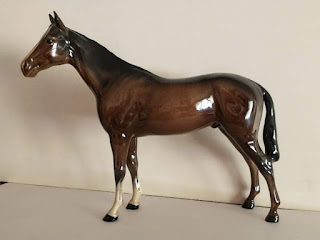
Baron Michelham, who died in 1919, had been a successful owner and breeder of Thoroughbred racehorses. The horse with whom he is most associated nowadays is the mare Plucky Liege (Spearmint–Concertina, by St. Simon), widely hailed as one of the most influential broodmares of her era. Among her produce were *Sir Gallahad III, sire of Triple Crown winner Gallant Fox (and grandsire of another Triple Crown winner, Omaha); *Bull Dog (grandsire of Triple Crown winner Citation); and Bois Roussel, a winner of the Epsom Derby whose likeness was sculpted by Arthur Gredington for the British ceramic manufacturer Royal Doulton. It is said that there is scarcely a Thoroughbred alive today that is not a descendant of Plucky Liege. 


Above: Plucky Liege. Below: A collectible ceramic statue of her son Bois Roussel, 
manufactured by Royal Doulton (courtesy of Susan Daigle-Leach).


Baron Michelham’s widow married Fred in February 1926 in Clearwater, Florida; she was 43, and he was 38. Within months she became ill, and she died the following January, “leaving the bulk of her fortune, estimated at $50 million, to Mr. Almy. In the inheritance was said to have been a palatial house in Paris, which Lord Michelham had lent to Prime Minister David Lloyd George as his residence and British headquarters during the 1919 Peace Conference” (New York Times, 2 January 1927).

Not long after his first wife’s death, Fred received an invitation to a fashion show from a French salon that she had often patronized, and he decided to attend the event by himself. There, he met a 20-year-old British model named June Dibble. They were married the following month in Paris and began spending their way through the Michelham fortune. The media dubbed Fred the “Cowboy Millionaire,” and for a number of years, everything he and his new bride did seemed to make the papers. 

Fred, however, hadn’t forgotten his Arizona friends. A newspaper article from January 1927, only weeks before his second marriage, noted that Fred had shipped two purebred Arabian stallions from Europe to General Levi Manning, onetime mayor of Tucson, Arizona, credited as the first breeder of purebred Arabian horses in the state. The headline read: “Fred Alma [sic] Coming from Abroad With Papers of Pedigree for Manning’s New Arabian Horses—‘Finest Ever Seen’” (Tucson Citizen, 19 January 1927). (Unfortunately, the names of these two horses are not known.) By this time, Manning already owned the Arabian stallions El Jafil (*Ibn Mahruss x Sheba), Jarad (Ziki x Tamarisk), Kalub (Ziki x Hasiker), and Saraband (Harara x Sedjur), all of which he had acquired from California with the help of a man named Hamilton Bassett, a self-proclaimed horse authority whose British-born wife passed herself off as “Lady” Betty Bassett. (One article about the couple noted incorrectly that Hamilton was “the first man to penetrate into [Tibet]” and that “Lady” Betty was the daughter of “Sir Joseph Grice-Emerson, and is a noted adventuress and explorer” (Republican-Gazette [Gove City, Kansas], 26 August 1915).

Fred and June began buying vast tracts of land in Arizona, including a 30-acre parcel in what is now metropolitan Phoenix, southwest of the intersection of Seventh and Maryland Avenues. While Fred purchased cattle, cars, and several Kentucky-bred racehorses, June became part of Phoenix’s social scene, showed horses, and even rode some of her husband’s racehorses at the Phoenix fairgrounds track. 

By this time, Fred had become so well known across the U.S. that someone named a racehorse after him. Born in 1929, the equine Fred Almy (Jack Hare Jr–Eleanor S., by Ivan The Terrible), owned by Cora Polk, ran for nine seasons, started a whopping 194 times, and won 27, including the 1931 Juvenile Handicap at Agua Caliente, in Tijuana, Mexico—where the “Millionaire Cowboy” also ran his own racehorses. (Presumably, the human Fred Almy was aware of his namesake, but it’s not known what he thought of him.)

Things seemed to be going splendidly for the Almys. One Los Angeles reporter remarked, “Quite a character, this Almy. Known all over Arizona as the ‘Millionaire Cowboy.’ Owns about half the state of Arizona, his friends say, and the cattle roam far and free on his vast ranches” (Los Angeles Daily News, 4 February 1930). What Fred and June’s friends didn’t know, however, was that a large part of his fortune had been wiped out in the 1929 stock market crash. Within a couple of years, the thousands of acres the couple had purchased on credit went into receivership. 

It’s unclear when June and Fred began to drift apart. In 1936, newspapers across the nation ran stories (complete with a topless photo) about June’s affair with a handsome married stockbroker named Jerry Wheelock. One reporter wrote, in a line that sounds particularly ludicrous to horse people, that Mrs. Wheelock demanded “a court snaffle to curb the Dawn Patrol canters of her playboy mate” (New York Daily News, 21 February 1936). By this time, June was living in New York and running a high-end florist shop. In 1939, June filed for divorce but asked for no alimony, as she was well aware that Fred had no money to give her (Albuquerque Journal, 10 November 1940). In fact, Fred was so poor that he didn’t have sufficient funds to attend his mother’s funeral. (Mrs. Almy wouldn’t have wanted him there, anyway, as she had cut him out of her will.)

                                     Cartoon in the Tacoma News Tribune, 11 October 1940. 

As Fred’s adventures receded from the headlines, it was his ex-wife whose name was again on the ascendancy. June made the national news for the last time in early 1943 after reporters learned that she’d married a wealthy, divorced lumberman, Albert Stanwood “Stan” Murphy. When Stan’s former paramour—a washed-up actress named Madge Bellamy—heard the news, she became so enraged that she drove to Stan’s club on San Francisco’s Nob Hill, waited for him to exit, and then shot at him with her revolver, but missed. The Texas-born Bellamy, who later told reporters that she was a good shot and “could have hit him” if she’d really wanted to, found herself back in the limelight for the first time in decades.

Bellamy’s movie career had certainly had its highs and lows—early on, she’d appeared in two John Ford pictures, including The Iron Horse (1924), and she earned a star on the Hollywood Walk of Fame. However, as she grew more difficult to work with, the only parts she was offered were in lower-quality fare, such as 1932’s White Zombie (1932), starring Bela Lugosi. By the time she shot at Murphy, Bellamy hadn’t worked in pictures for six years. She never served time for her crime, and instead received a six-month suspended sentence for violating a gun law. Later in 1943, Bellamy sued Stan in Nevada, on the grounds that they had been married there in 1941. However, no evidence of their putative marriage ever came to light, and the case was dismissed. Stan reportedly gave her a six-figure settlement to get her out of his life. 

                                    Bela Lugosi and Madge Bellamy in White Zombie (1932). 

Stan had become acquainted with Fred Almy several years before either of them met June. The two men had visited Arizona back when both of them were bachelors. In fact, in the summer of 1915, Stan and Fred dined together twice at Riverside, an amusement park south of downtown Phoenix that featured a large swimming pool, a zoo, and live music (Arizona Republic, 16 May and 20 June 1915). Stan married his first wife in 1917, and although the couple lived in California, they periodically visited Phoenix, where June and Stan likely became acquainted. As the San Francisco Chronicle noted, “No whirlwind romance was theirs, Stan and June having met some years ago when both had marital commitments” (10 January 1943).

The Murphys’ marriage appears to have been happier, and considerably more sedate, than their previous relationships. After 20 years of marriage to June, Stan died in April 1963 at age 70. Two years later, Fred Almy—who had eked out a living by hauling other people’s racehorses from track to track—died in his room at a seedy hotel near Hell’s Kitchen in New York. He was 77. For the next two decades, June lived quietly, never remarried, and passed away in San Francisco in 1986. 

Three years after Fred Almy’s death, a chestnut filly was born on Frank Brophy’s 30,000-acre Babacomari Ranch in southern Arizona. Her sire, the stakes-winning Whodunit, stood at Claiborne Farm and was, like Secretariat, a grandson of *Princequillo. The filly’s dam, Flower Pot, a daughter of Delphinium, had been bred and raised by Brophy. By that time, Brophy had been breeding and racing Thoroughbreds in Arizona and California for four decades, had served on the board of the Arizona Racing Commission, and had been dubbed “the patriarch of Arizona racing.” There’s no indication that Brophy had kept in touch with June (Almy) Murphy since the 1930s. However, something about this particular filly clearly reminded him of the beautiful young model who, with her husband Fred, the onetime “Cowboy Millionaire,” kept Arizona residents—and the nation—riveted during the Depression as they blew through $50 million in track record time.

                                                           June Almy (b. 1903, d. 1986).